Sponsorship Ops
Part of Podcast sponsorship operations
Arranging makegoods for missed podcast placements
Define a missed podcast placement, assess a proposed replacement and record whether it resolves the original booking.
Open a makegood discussion by identifying the obligation that may have been missed and the evidence for it. Compare any proposed remedy with the original campaign purpose and the booking terms. An extra ad elsewhere is not automatically an acceptable replacement, and a result below a forecast is not automatically a breach.
Establish the shortfall
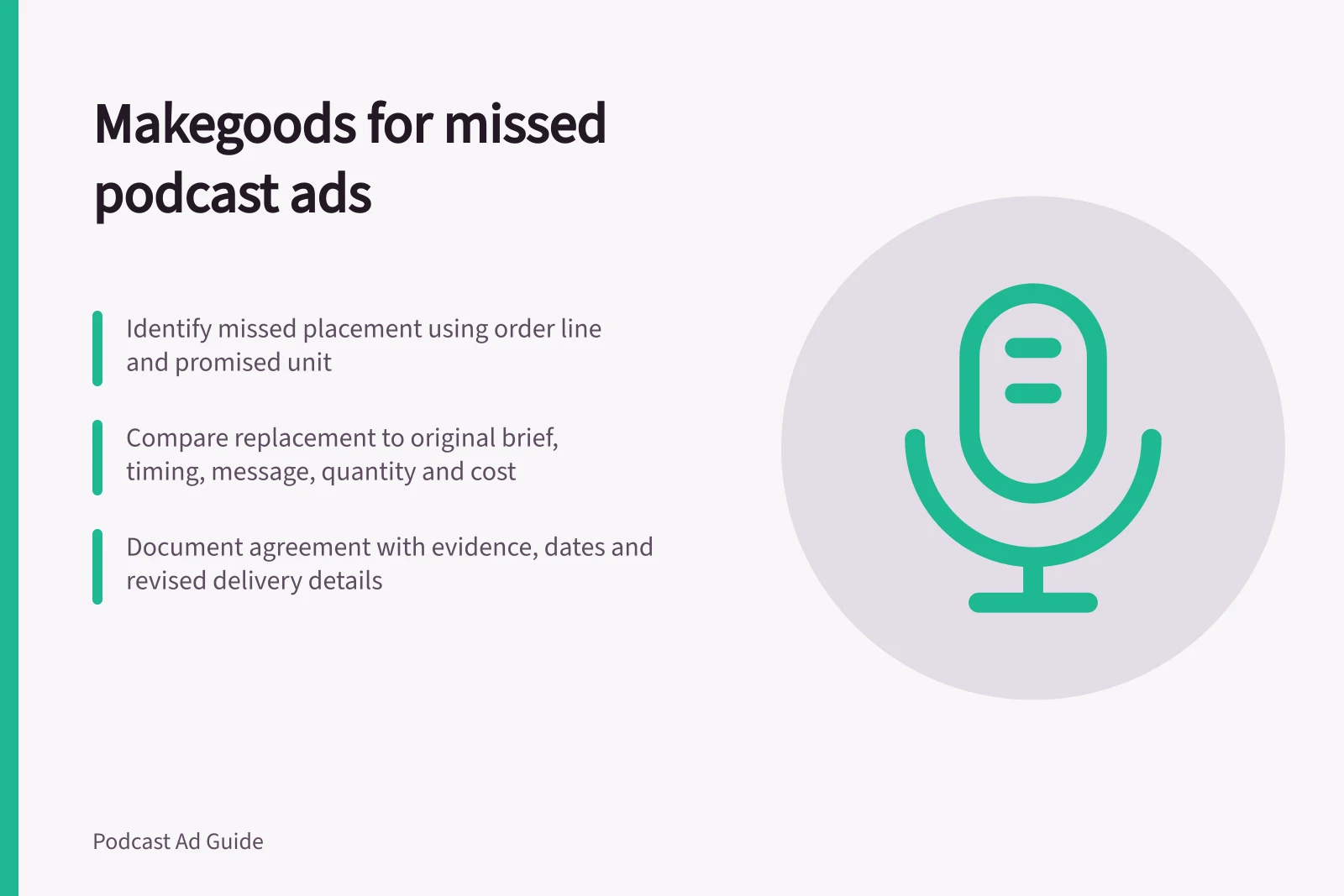
Identify the order line and the promised unit. Check whether a named episode was omitted or released late, whether the agreed position or recording was wrong, and whether a committed count of eligible ad deliveries fell short. If the order includes both, check a named placement and a quantity commitment separately.
Ask the publisher for the relevant episode or campaign record, covering creative, period, eligible inventory and any agreed Australian geographic rule. Align reporting cut-offs before comparing counts. If the report says “impressions”, ask which event that label represents.
IAB Tech Lab’s Podcast Technical Measurement Guidelines, version 2.3, address measurement of downloaded media and the ads included in those downloads. The seller’s actual method and the order govern the shortfall decision.
Key Metrics for Validating a Makegood
- Eligible Ad Deliveries
- Confirmed against the agreed count in the insertion order
- Reporting Cut-off Alignment
- Must match between buyer and seller for accurate comparison
- Australian Geographic Rule
- Validated if applied in the booking and delivery
- Impression Event Definition
- Clarify if 'impressions' refer to downloads, plays, or starts per IAB standards
Assess the replacement
A reviewable proposal identifies the replacement show or episode, position where relevant, recording, Australian eligibility, dates, delivery unit and evidence the seller will supply. Compare it with the missed line:
- Audience and context:
- Does it still fit the agreed brief and exclusions?
- Timing:
- Will it run while the offer and campaign purpose remain relevant?
- Message:
- Is the existing recording still accurate and authorised there?
- Quantity:
- Does it address the same committed unit, if one was promised?
- Cost:
- Does it change media, production or talent charges?
Possible remedies to discuss include re-running the missed work, a future credit, or a full or partial refund. These are options to negotiate, not automatic rights; the booking terms and the buyer’s purpose determine whether a proposed remedy resolves the shortfall.
For any credit or refund, ask the seller to state whether it is full or partial, its value and the basis for that value. Compare the proposal with the missed line and any changed charges; do not treat an unexplained amount as an agreed resolution.
These are questions for the buyer and seller, not a universal right to equivalent inventory. Check the agreed remedy and obtain written approval for a material change beyond it before the replacement runs.
Missed Placement vs. Proposed Replacement: Key Criteria
- Audience and contextDoes the replacement show match the target demographic and exclusions agreed in the booking?
- TimingIs the replacement airing while the campaign offer remains relevant (e.g., during promotion window)?
- Message accuracyIs the existing recording still valid and authorised for the new placement?
- QuantityDoes the replacement deliver the same committed number of eligible ad deliveries?
- CostAre there changes to media, production, or talent fees that affect the overall value?
Decide and document
Accept a proposal that meets the agreed remedy and the buyer’s purpose. Request a revision if its timing, inventory or counted unit does not. Hold the decision if the evidence needed to establish the shortfall is missing. For example, total show downloads cannot simply replace a committed count of deliveries of the advertiser’s ad.
Record the decision in an email trail tied to the original insertion order. State the missed line, agreed remedy, any agreed value or changed total charges, replacement details, dates and evidence required; keep the agreement, insertion order and any relevant invoice consistent.
Mark the exception closed only when the revised obligation has been delivered and checked. State any remaining open placement or quantity so the campaign closeout does not hide it.