Sponsorship Ops
Part of Podcast ad frequency and reach
Managing frequency in dynamically inserted campaigns
Define the scope and timing of a podcast frequency cap, check identification limits, and monitor delivery in a dynamically inserted campaign.
Define what a cap covers, the period in which it resets and how recipients are counted. Then check delivery and estimated frequency during the campaign. A seller's cap can govern eligible delivery within its system. It does not establish how often a person listened across every platform.
Specify the rule before booking
Ask whether the cap applies to a creative, ad group, campaign, show or entire buy. If several versions of the message run, confirm whether they count together. For inventory from multiple publishers, ask whether one rule covers all of it. Record the agreed scope and reset period in the booking.
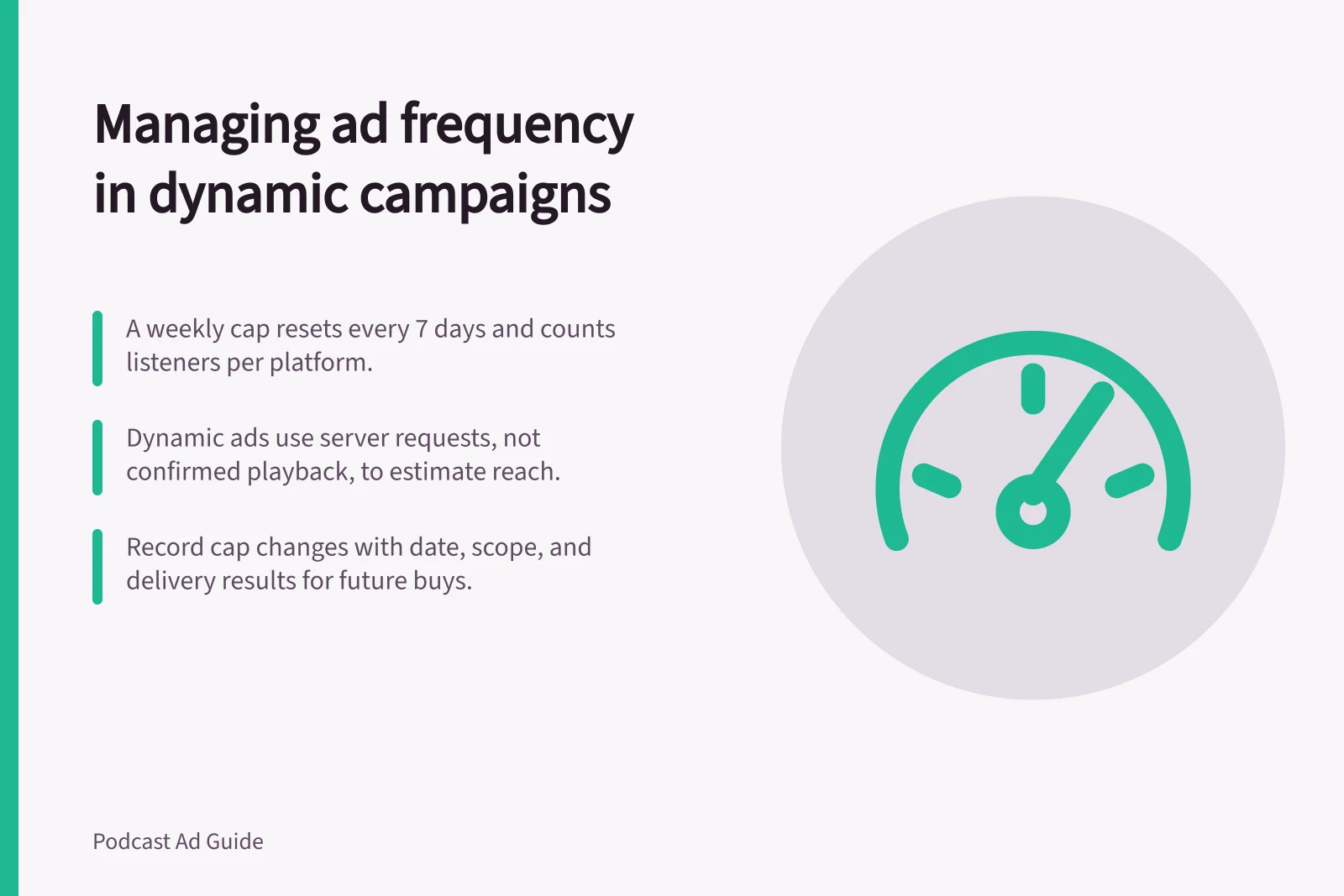
A weekly cap resets differently from a campaign-long cap. Ask what happens when the seller cannot recognise a returning recipient. Confirm which rule is available for the proposed podcast inventory rather than assuming that a platform's general advertising controls apply to every placement.
Acast's advertiser help describes a configurable maximum per listener per week. The control's identity and cross-publisher limits are not fully specified, and its use of 'hear' should not be read as proof of playback. Confirm the control's scope and availability for the specific buy.
Frequency Cap Reset Periods: Weekly vs Campaign-Long
- Reset Period
- Weekly
- Reset Period
- Campaign-long
- Scope Flexibility
- Limited to one week; resets every Monday
- Scope Flexibility
- Applies across entire campaign duration; no intermediate reset
- Best For
- Consistent, ongoing exposure without repetition
- Best For
- High-impact, limited-duration messaging
Understand the counting limit
In open podcast delivery, filtered server requests may estimate a recipient using IP address and user agent. An IP address can change for one consumer or be shared by several. Dynamically inserted ads can be selected at an episode request, but a server-counted delivery is still distinct from confirmed playback.
Ask how the seller handles multiple devices, changing addresses, repeat downloads and inventory outside its system. Treat the cap as a rule applied to the seller's available signals, not a guarantee about a person's total exposure.
Limitations of Server-Based Counting in Dynamic Ads
- Pros
- Uses IP address and user agent for initial recipient estimation
- Cons
- IP addresses may change or be shared across users
- Pros
- Enables tracking at episode request level
- Cons
- Does not confirm actual playback or listener identity
Monitor delivery and changes
Before launch, request forecast impressions, estimated unique reach and average frequency under the proposed cap. If available, compare forecasts under a tighter and a looser rule to see how delivery might change. There is no universal best cap for every campaign.
During the flight, review pacing and estimated frequency by period and, where available, by show. If delivery falls behind, check eligible inventory, targeting and the cap before changing it. If impressions rise while estimated reach barely changes, ask whether repeat deliveries are concentrated among earlier estimated recipients; request a distribution if one is available.
Record any cap change with its date and scope. At close, report the intended rule, measured delivery and inventory the rule did not cover. That record is more useful for the next buy than a claim of perfect control over listening.
Key Frequency Cap Metrics to Monitor
- Forecast Impressions
- Available pre-launch
- Estimated Unique Reach
- Measured per period and show
- Average Frequency
- Monitored during campaign flight
- Repeat Delivery Concentration
- Check if concentrated among early listeners