Sponsorship Ops
Part of Podcast sponsorship operations
Closing a podcast campaign with delivery evidence
Turn podcast delivery evidence into line-by-line sign-off decisions and hand unresolved obligations to the right owner.
Close a podcast campaign by deciding each obligation in the final approved order: accepted, pending evidence or disputed. Every open line needs an owner and next action. A campaign total may support the account, but it cannot alone verify a named placement, approved recording or agreed replacement.
Assemble the closeout record
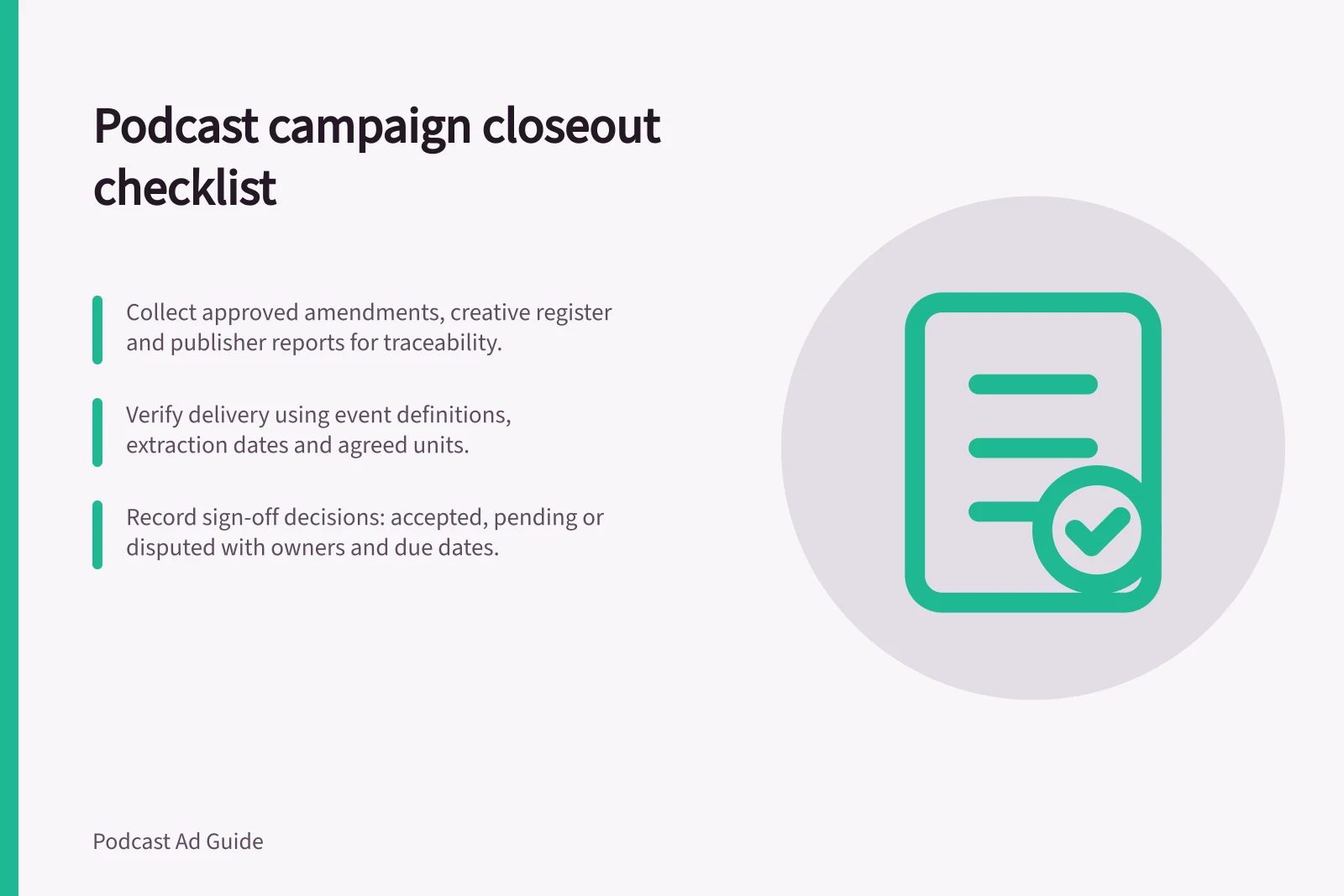
Collect the order, approved amendments, creative register, publisher reports and resolved makegood agreements. For each line, identify what was promised: show or eligible inventory, episode or flight dates, position where agreed, creative version, any Australian geographic rule and committed unit. Keep original terms beside amendments so each change stays traceable.
State the reporting cut-off and extraction date. An episode released near the cut-off may accrue later eligible downloads, so label a report provisional if its agreed delivery window is still open. The advertiser’s response window can differ from the media delivery window.
Decide what the evidence supports
| Obligation | Evidence to examine | Limit |
|---|---|---|
| Ad embedded in a named episode | Episode identity and a copy or timestamp showing the approved segment | That copy does not establish total distribution. |
| Dynamic delivery | Creative-level report for eligible inventory, dates and geography | One playback cannot represent every request. |
| Committed quantity | Count, event definition and agreed period | The event must match the booked unit. |
| Approved replacement | Written change and evidence it ran | Approval alone does not establish delivery. |
Ask the publisher to define “impression”. Apply the definition in its report and the unit in the order.
Record the sign-off decision
For an accepted line, name the evidence that answers the booking. For pending evidence, name the missing item, supplier and due date. For a disputed line, state the conflicting facts or interpretation and the decision owner. Keep a shortfall or changed placement on its own line until its remedy has been checked.
This step takes the line-item reconciliation as input; its output is an acceptance decision. Do not treat favourable sales or response as a substitute for an undelivered media obligation.
Hand over the pack
Store together the order and changes, authorised audio and IDs, reports with their definitions and extraction dates, episode checks, makegood decisions, line statuses and invoice questions. Give finance the accepted obligations and open payment questions. Give reporting colleagues the confirmed delivery basis and its limits. Keep any dispute visible rather than presenting it as settled.
Business response and campaign effect belong in the media report, under their own sources and observation windows.