Sponsorship Ops
Part of Podcast sponsorship operations
Tracking ad versions and expiry dates
Control approved podcast ad recordings, offer expiry and delivery dates so each show uses the authorised version.
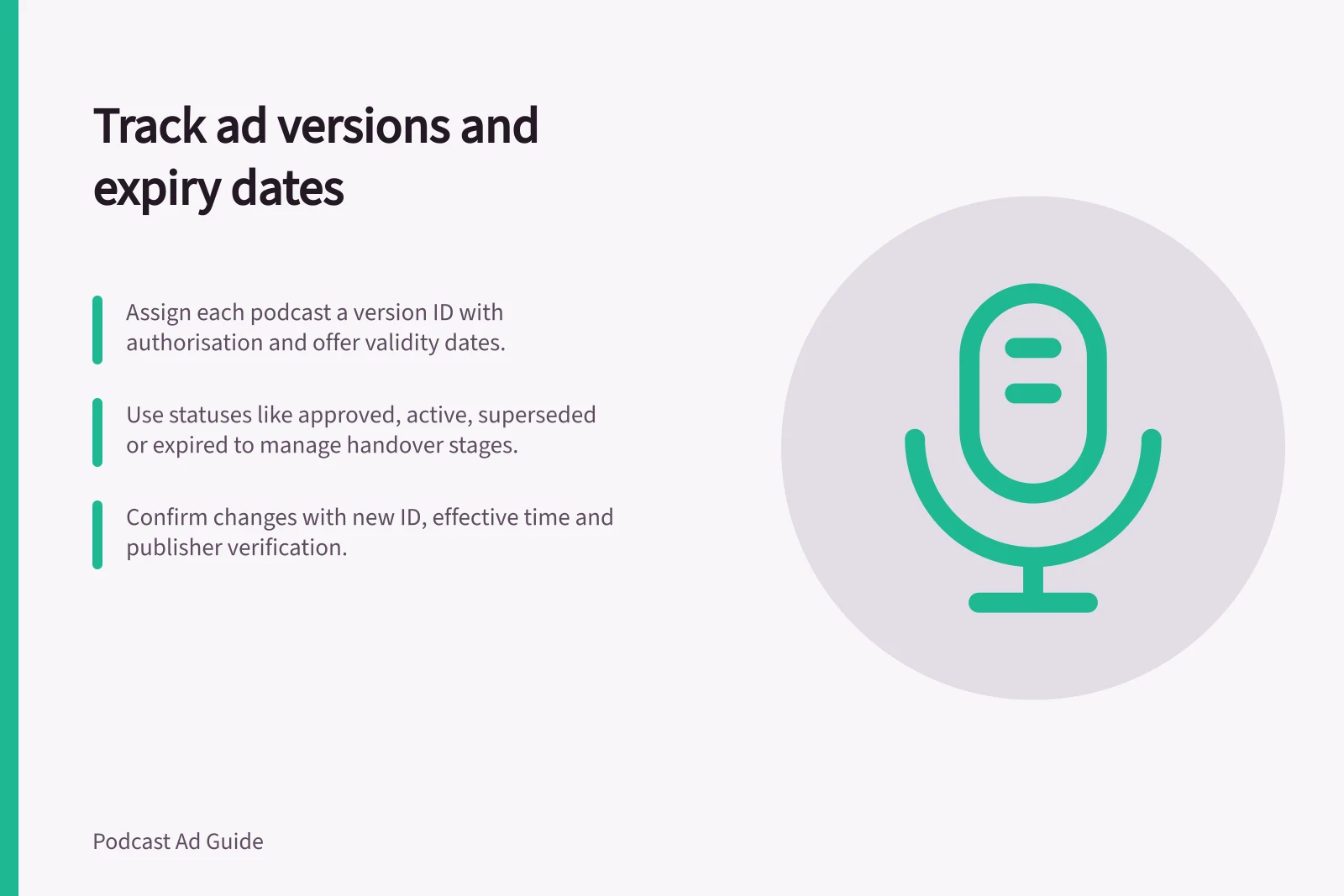
Give each podcast recording a version ID and keep two dates apart: when the publisher is authorised to deliver it and when its offer is valid for customers.
Match the version to the shows or campaign rules that may use it. When terms change, identify the affected audio and confirm what the publisher can stop or replace.
Keep an asset register
For each version, store the file, ID, host or voice, approved wording or talking points, approval date, spoken destination, offer terms, permitted delivery period and authorised placements. “Latest ad” is too vague when different hosts have different approved reads.
Use statuses such as in review, approved, scheduled, active and superseded to describe the handover. An expired status means the version is no longer authorised for future delivery under the campaign; it does not mean every existing copy has disappeared. Name the owner who will obtain publisher confirmation of a change.
| Change | Check before continuing delivery |
|---|---|
| Offer date changes | Does the spoken date remain true, and which version may run? |
| Code or destination changes | Does the recording still direct listeners to the intended route? |
| Product condition changes | Which claim or qualification needs review? |
| Another host records the message | Which file is approved for that host and booking? |
Key metadata to store for each ad version
- Version ID
- Unique identifier for tracking across systems
- Approved wording
- Exact script or talking points used in recording
- Permitted delivery period
- Start and end dates for airing the ad
- Authorised placements
- Specific shows, seasons or campaigns allowed to use this version
- Status
- in review, approved, scheduled, active, superseded, expired
Separate the two expiry decisions
An offer end date does not automatically provide a sensible last delivery date. Agree the delivery cut-off with the advertiser and publisher in light of when someone may encounter and act on the ad.
There is no universal number of days to subtract. Decide what the destination will explain to someone who hears an older recording after the offer ends.
The ACCC accepts reports about possible misleading or false claims and may use them in its education, compliance and enforcement work.
Match the control to the delivery method
With dynamic insertion, a publisher may select creative for future eligible episode requests. Ask which shows and older episodes qualify, what pause or replacement control exists and when a change takes effect. Acast describes dynamic ad insertion and separately offers users the option to book host-read sponsorships or run pre-recorded ads; that does not establish another publisher’s controls.
An embedded ad is part of the episode file. Ask whether the publisher can edit the file for future downloads. Copies already obtained by listeners may remain beyond its control. Avoid recording an embedded version as “removed everywhere” because a revised episode has been uploaded.
Confirm the change
Send an instruction naming the old and new IDs, affected inventory, effective time and approver. Ask the publisher to confirm the scheduled state and request creative-level delivery reporting where available. One sample playback can reveal an error but cannot show every creative served dynamically. Keep the superseded file and decision history so the authorised version for each period can be identified at close.