
Measurement
Part of Managing host-read advertising
Collecting evidence that a booked host read aired
A booking confirmation proves an ad was scheduled, not that the approved host read reached listeners as agreed.
A booking confirmation proves an ad was scheduled, not that the approved host read aired. Match your evidence to the contract and booking confirmation: the episode, date or insertion window, position, duration and creative version.
For an episode-embedded read, ask the publisher for the released episode and timestamp. Listen to the segment and save the episode and timestamp as evidence that the read appeared in that release.
For dynamically inserted inventory, ask the publisher for its delivery report and a sample or creative ID. Match these to the booked insertion window and creative version; a single playback may not represent every listener’s ad.
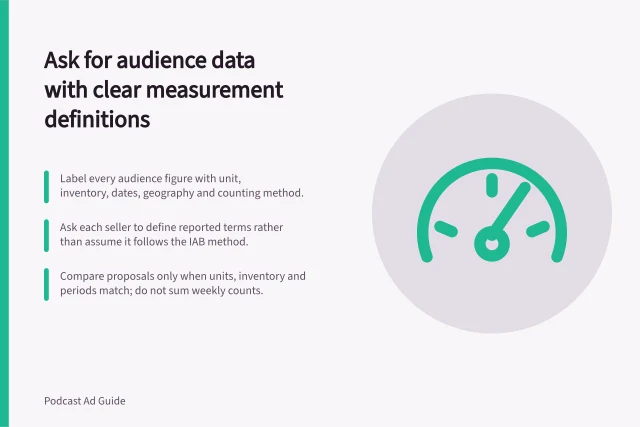
Ask the seller to define whether each reported figure is an ad start, download, impression or another event, and keep those definitions with the figures. The IAB Podcast Measurement Technical Guidelines provide a reference for podcast ad and audience measurement; their 2017 update addressed inconsistent download definitions.
Server-side measurement logs each time an audio player requests a podcast from a server and generates download metrics. Those metrics cannot establish that the podcast was actually listened to, so do not treat downloads, ad starts and impressions as equivalent without the seller’s definitions.
Keep one campaign file with the booking confirmation and contract, approved creative, released episode and timestamp or delivery report with sample or creative ID, the seller’s metric definitions, any discrepancy record and the invoice. Keep the evidence with the order and invoice.
If the seller does not provide a delivery report or creative ID, record that gap and resolve it with the publisher under the booking terms. Where reach figures are unavailable or modelled, say so rather than presenting them as verified.
The aired segment is the record to check for sponsor identification, claims, offer terms and action. The AANA Code of Ethics states its object is to ensure advertisements are legal, honest and truthful; its Practice Note guides advertisers and complainants, and the Ad Standards Community Panel applies it in determinations.
If the read differs materially from approval, record the discrepancy and resolve it with the publisher under the booking terms. A credible campaign record states what can be verified and what remains an estimate.
Campaign evidence file checklist
- Booking confirmation and contract
- Approved creative, including the creative version
- Released episode and timestamp, or delivery report with sample or creative ID
- The seller's definitions for each reported metric (ad start, download, impression or other event)
- Any discrepancy record, including missing delivery reports or creative IDs
- Invoice, kept with the order and the rest of the evidence
- A note on what remains an estimate, such as unavailable or modelled reach figures