
Host-Read Ads
Managing host-read advertising
A host read is advertising delivered in the host's voice and style.
A host read is advertising delivered in the host's voice and style. It works best when the sponsor's claim is accurate, the commercial nature is clear and the host has enough room to sound like themselves.
Management spans the brief, recording, approval, delivery and evidence of what aired. Keep a written record at each stage — the agreed brief, the approved read, the booked placement and the delivery report — so a gap can be traced to one step rather than the whole campaign.
Start with a brief that separates required facts from optional phrasing. The companion article on briefing a host covers claims, prohibited claims and personal-use statements in detail.
Spotify's creative guidance notes that some podcast hosts signal when an ad break is coming and others do not. Agree how the sponsor will be identified before recording begins.
Assess the show's character alongside its audience before committing to a host read. A message designed for an emotionally driven show may need a different creative approach from one in a news show, even when both reach a relevant audience.
The format choice affects campaign flexibility. Spotify distinguishes host reads, voiced by the show's host in the show's style, from voice-talent ads made for a podcast environment. Voice-talent ads can be more easily scaled across shows and audiences.
Managing a Host-Read Advertising Campaign
- Develop a Clear BriefSeparate required facts from optional phrasing; include claims, prohibited claims, and personal-use statements
- Agree on Format and IdentificationDecide how sponsor will be identified; confirm if audio-only or video format is used
- Record the Host ReadEnsure host maintains authenticity while delivering key messages accurately
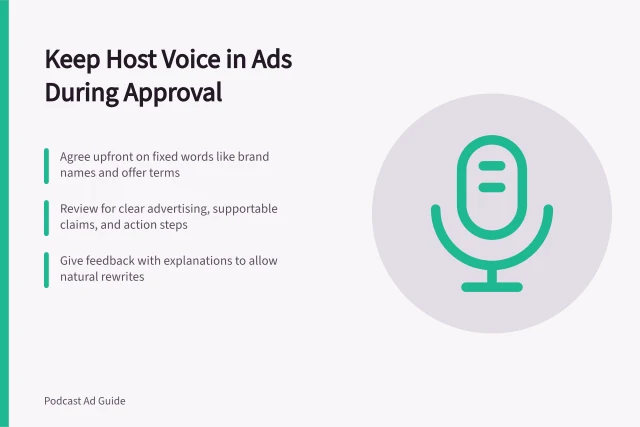
- Approve Content for Meaning, Not Word-for-WordFocus on claim accuracy and compliance; agree on approval process and sign-off authority
- Confirm Delivery and Retain RecordsKeep records of agreed episode, placement, duration, and delivery report for audit and reconciliation
- Measure Results with Honest LimitsUse dedicated codes or URLs; avoid overclaiming attributed actions as all incremental conversions
Choose a show that fits the campaign
Show selection is a creative decision as well as an audience decision. Spotify notes that each podcast has a distinct character, such as informative, fun or mysterious, which can influence what creative approach suits it.
Match the message's style to the show's character. Spotify recommends narrative-driven, equity-focused creative for emotionally driven shows, while informational and feature-focused messaging may suit news content.
A host read can be useful when introducing a new product or brand, or when the message needs more room to develop. Its connection with the host may help build an emotional relationship with listeners.
A host read is less flexible and scalable than a voice-talent ad. Where a campaign needs to reach many shows at once, a voice-talent buy will scale more easily.
Pros and Cons of Host-Read Advertising
- ProsBuilds trust through authentic host voice; strengthens emotional connection with audience; effective for new product launches; enhances brand credibility
- ConsLess scalable than voice-talent ads; higher production cost; limited flexibility for changes post-recording; harder to track performance without dedicated tracking tools
Set the format, duration and investment
Set the expected duration before production. Spotify's guidance says host-read ads are most effective at no more than 60 seconds, noting that listeners are more likely to skip ahead after that.
Confirm whether the booked host read will be audio-only or also delivered in video. Podcast advertising can appear in video formats as well as audio, and advertisers can choose a format based on their target audience and performance objectives, or use both to extend reach.
Allow for the bespoke nature of the work when comparing costs. SiriusXM Media notes that host reads usually cost more than announcer- or brand-read ads. Compare the host-read rate with the cost of a voice-talent buy across several shows before committing.
Host Read vs Voice-Talent Ads: Key Differences
- Flexibility and ScalabilityLow (host read is bespoke); High (voice-talent ads can be reused across multiple shows)
- CostHigher (host reads are custom and involve the host’s time and voice); Lower (voice-talent ads are standardised and more cost-efficient at scale)
- Creative AuthenticityHigh (hosts deliver in their natural style, building trust with listeners); Moderate (voice talent mimics podcast tone but lacks personal connection)
- Best Use CaseIntroducing new products or brands; emotional storytelling; building brand affinity
Podcast Ad Performance Insights (Australia)
- Optimal Host Read Duration
- ≤60 seconds
- Listener Skip Rate After 60s
- Higher (listeners more likely to skip ahead)
- Ad Standards Compliance Scope (AANA Code)
- Applies when potential customers are physically present in Australia
- Evidence of Airing Required
- Yes – proof of playout, dynamic insertion and reconciliation needed
Approve meaning and preserve voice
Approval is about the substance of the read rather than a word-for-word match to the draft. Agree in advance how the read will be approved and who signs off on a change to the agreed wording. The companion articles on approving a host-read script and on unscripted comments cover how to review claims and what to do when a host departs from the script.
Keep the agreed episode or insertion window, position and duration on file so that delivery can be checked against the booking. The companion article on evidence of airing covers proofs of playout, dynamic insertion and reconciliation.
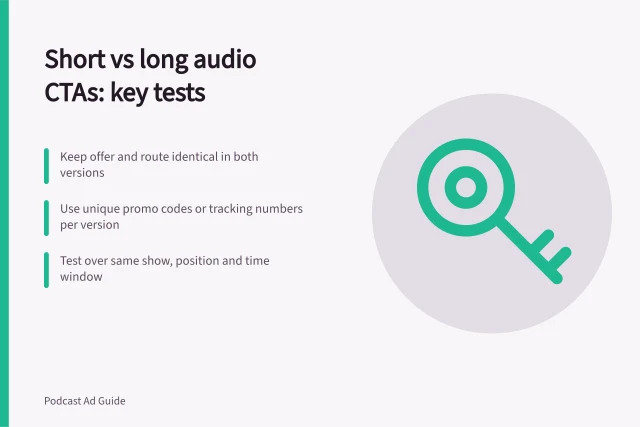
Measure results with honest limits. A dedicated code or address can help identify response but misses listeners who act later or through another route. Do not present attributed actions as all additional customers. Close with a record of what actually ran, what was approved and what should change for the next read.
The AANA Code of Ethics is part of advertising and marketing self-regulation and applies to material under an advertiser's reasonable control, whether or not payment or other valuable consideration is involved.
The Code's stated scope includes marketing communications where potential customers are physically present in Australia. It is accompanied by a Practice Note that guides advertisers and complainants and is used by the Ad Standards Community Panel in making determinations.
In this guide
- Approving a host-read script without losing its natural voiceApproval should protect meaning, not flatten a host read into copy that anyone could recite.
- Handling unscripted comments in a sponsored readUnscripted comments can make a host read engaging, but they can also add an unsupported product claim or imply personal experience that did not occur.
- Collecting evidence that a booked host read airedA booking confirmation proves an ad was scheduled, not that the approved host read reached listeners as agreed.