Show Selection
Part of Selecting podcast partners
Assessing host fit for a technical or sensitive product
Decide whether a podcast host can explain a careful product claim accurately and work with the required review process.
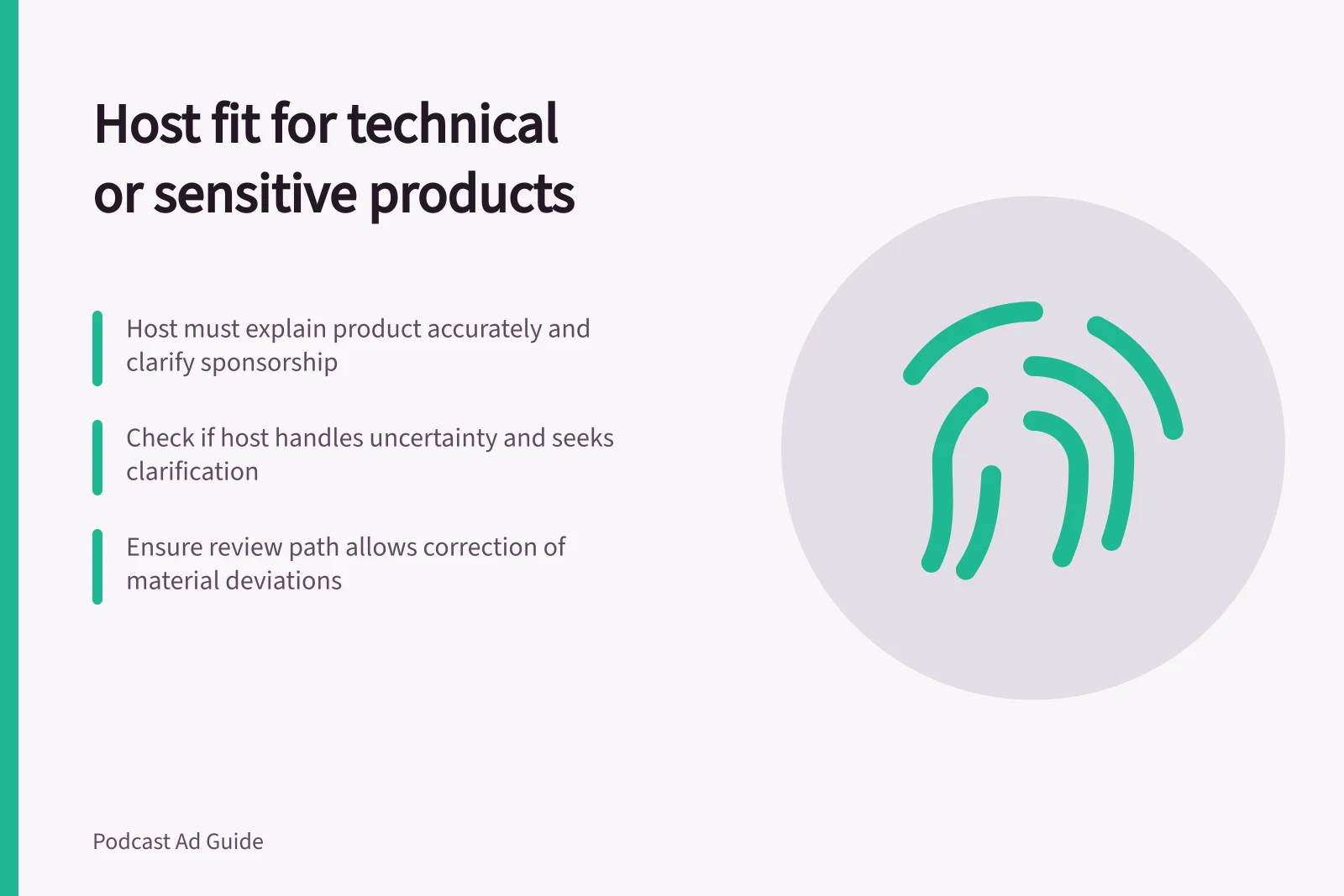
Choose a host who can explain the product accurately, recognise uncertainty and make the sponsorship clear. An engaging delivery cannot make an unsupported claim or an unworkable approval process suitable.
Define the explanation the host must give
Write a plain-language description of the product and the distinction a listener needs to understand. Place any eligibility, availability or other condition beside the benefit it qualifies. Separate established facts from questions that still need the advertiser's specialist to answer.
For a technical product, consider whether the host can explain the distinction without replacing it with an inaccurate promise. For a sensitive product, consider whether the show's usual tone leaves room for a measured explanation.
The advertiser's responsible specialist must determine which claims require formal review. Selecting a host does not settle product-specific requirements.
Pros and Cons of Using a Host with Limited Expertise on Sensitive Products
- ProsGreater audience reach due to host's existing credibility; natural delivery increases listener trust
- ConsRisk of oversimplification or misrepresentation; may struggle with nuanced conditions or eligibility requirements
Listen for judgement
In recent full episodes, hear how the host handles subjects outside their expertise. Do they seek clarification, distinguish opinion from fact and acknowledge uncertainty? Listen to existing sponsored segments as well. A natural read is useful only if the approved meaning survives it.
Before selecting the partner, discuss the proposed product with the host or producer. Ask the host to explain the central idea in their own words and say which points feel unclear or uncomfortable. That conversation can reveal a poor fit; it cannot prove how a future recording will turn out.
Set truthful boundaries for personal voice
A host can explain a product without claiming to have used it. If a first-person account is proposed, check that it is true and relevant. Do not build a placement around an invented testimonial. Make the sponsorship clear in context.
The ACCC says it can require businesses to back up claims they make about their products or services. Consider whether the host can say an essential condition clearly at a natural pace. If the explanation becomes crowded, narrow the claim or consider a different voice or format.
Check the review path
Ask who receives the factual brief, who reviews proposed wording, whether final audio can be checked and how a material deviation would be corrected. For a time-limited claim, confirm what the publisher can change or stop under the proposed delivery method.
Proceed when the host can explain the approved proposition in a voice that fits the show and the partner can support the required review. Otherwise, request a different host, a narrower message or a separately recorded spot.
Review Path for Sponsored Product Claims
- Who receives the factual brief?Advertiser’s responsible specialist
- Who reviews proposed wording?Legal or compliance team + host or producer
- Can final audio be checked before release?Yes, prior to broadcast
- How is a material deviation corrected?Re-recorded or pulled from schedule with notification