Show Selection
Part of Podcast advertising for different purchase cycles
Choosing a test period for a product with delayed sales
Set separate podcast ad, response and sales review periods so a product with delayed sales is not judged too early.
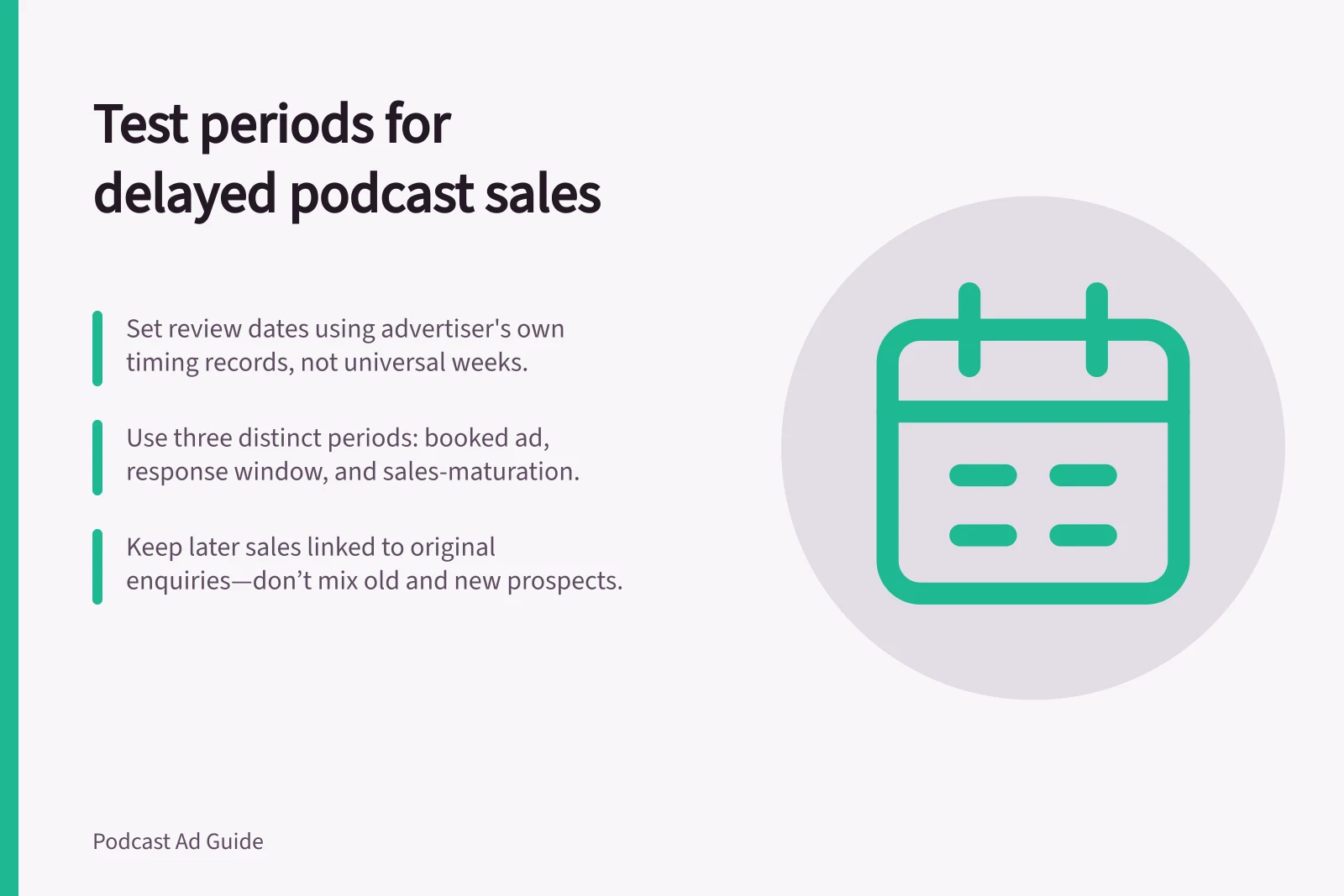
Separate the booked ad period, the response window and the time allowed for sales to mature when setting a podcast test period. Ads may finish before all useful enquiries arrive, and those enquiries may take longer to become sales. Set review dates from the advertiser's own timing records; there is no universal number of weeks.
Find the delay relevant to the decision
If the immediate question is whether the ad and response route work, review them soon after launch. If it is whether enquiries are useful, allow for response and the team's assessment. If the spending decision depends on completed sales, allow for the usual interval from enquiry to outcome.
Use dated records from comparable customers where available. Examine the range of delays, not only the average, and check that the earlier product, offer and sales process resemble the proposed campaign. If reliable history is missing, name the uncertainty and plan an early operational review followed by a later sales review.
The booked ad period must also suit the planned delivery. Check the seller's forecast, eligible inventory and budget when setting it. Keeping ads live for the entire sales cycle is not required merely because sales are delayed; extending observation after the ads stop may answer the sales question. The amount of delivery needed to compare messages is a separate test-design decision.
Key Considerations for Campaign Evaluation Timing
- Use dated records from comparable customers
- Where available, examine range of delays—not just average
- Check process similarity
- Ensure earlier product, offer and sales process resemble proposed campaign
- Plan for uncertainty
- Name unknowns; schedule early operational review and later sales review
Put three periods on the brief
| Period | Boundary to record | What it helps answer |
|---|---|---|
| Booked ad period | Agreed start and end dates for eligible placement or delivery | Whether the planned media ran under the booking |
| Response window | Agreed dates for recorded visits or enquiries | Which actions appeared after the campaign could be encountered |
| Sales-maturation period | Each enquiry or first-order date through its outcome cut-off | What happened after a comparable amount of follow-up |
These periods can overlap. Record the dates, time zone, eligible customers and data extraction date. For an embedded ad, downloads may continue outside a planned campaign period; the booking and actual delivery evidence must be described separately.
Keep a later sale with its original enquiry group. Simply counting all sales in a later calendar period mixes old and new prospects.
Key Review Periods for Podcast Ad Campaigns with Delayed Sales
- Booked Ad Period
- Agreed start and end dates for eligible placement or delivery
- Response Window
- Agreed dates for recorded visits or enquiries
- Sales-Maturation Period
- Each enquiry or first-order date through its outcome cut-off
Avoid an early verdict
At the first review, check delivery against the booking and whether the response route worked. Apply the enquiry definition chosen before launch and mark unresolved records pending. Few completed sales at this point may reflect normal delay, weak demand or both.
At the later review, compare groups with similar time to mature. The last week's enquiries have had less follow-up than earlier ones; wait or label their result provisional. Use the advertiser's outcome records separately from publisher delivery.
The IAB Tech Lab guidelines address measurement of downloaded media and the ads included in those downloads. Confirm the actual seller's metric. Dedicated pages and codes identify only observable routes, and other marketing or sales work may contribute to later orders.
Write down an operational-check date, an enquiry-quality date and a mature-sales date before launch. State what each decision needs. If the aim is to estimate incremental sales, plan a suitable comparison and sample in advance.
More calendar time alone does not make an uncontrolled before-and-after result causal. Extend observation when unresolved enquiries could still change the decision, and say when the sales evidence remains immature.
Recommended Review Process for Delayed-Sales Campaigns
- Operational CheckVerify delivery against booking; confirm response route functionality
- Enquiry-Quality DateApply pre-defined enquiry criteria; mark unresolved records pending
- Mature-Sales DateCompare groups with similar time to mature; avoid premature conclusions