Host-Read Ads
Part of Podcast advertising for different purchase cycles
Designing a podcast offer for repeat-purchase products
Build a podcast offer that supports first trial, states conditions clearly and allows a fair review of later repeat orders.
Design a podcast offer around the first order and the reason a customer might return. An introductory incentive can encourage trial; redemptions do not show whether customers will buy again.
Make the benefit and restrictions clear. Review later orders from the first-purchase group after enough time has passed for another purchase to be plausible.
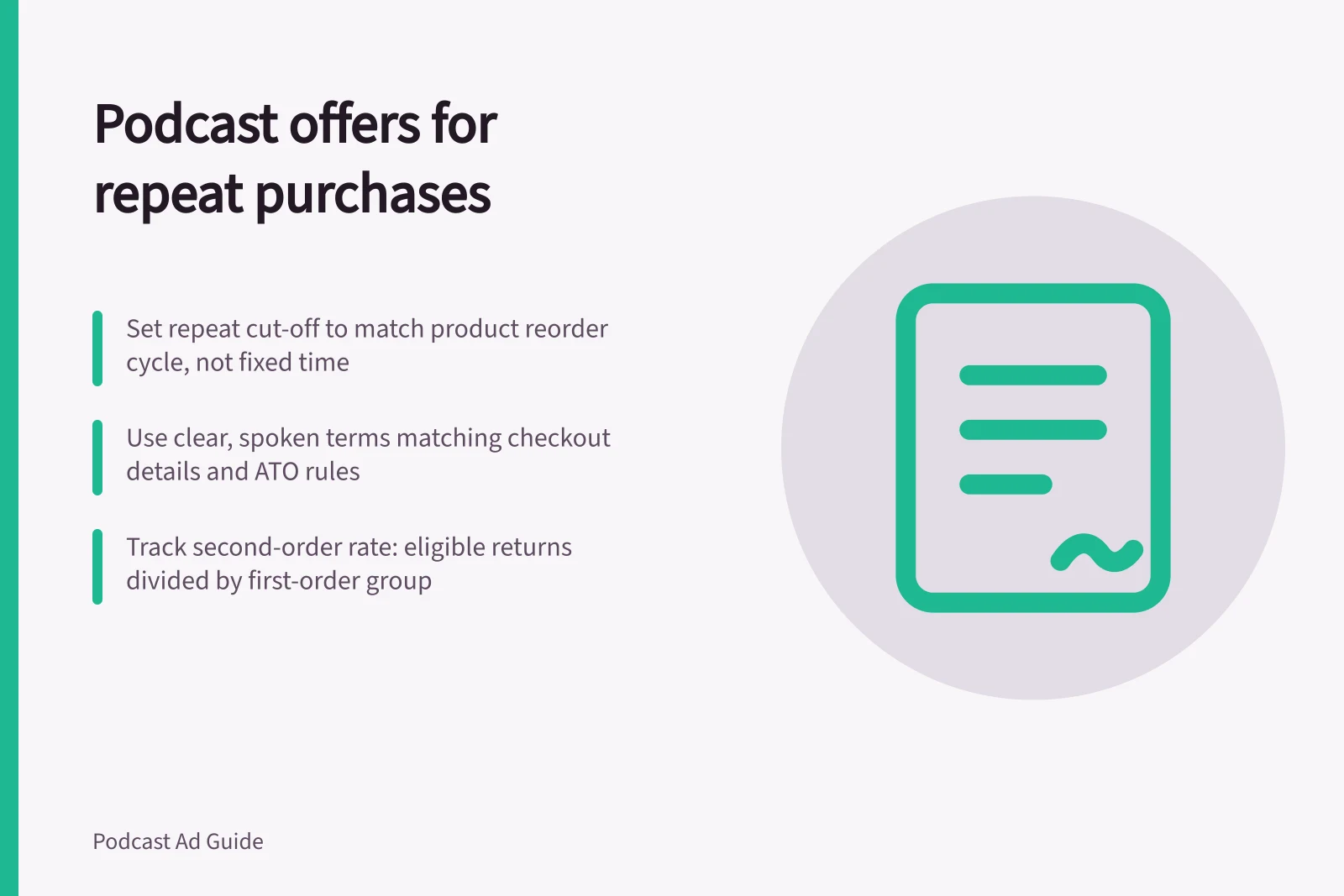
Set the repeat cut-off from the product’s actual use and reorder cycle. A three-month reporting period is one illustration, not a universal maturity window.
Decide what the first offer needs to change
Identify the obstacle to trial. A new customer may need a smaller quantity, help choosing a variant or a price incentive. Choose an offer that addresses that obstacle without adding conditions the audio cannot explain clearly. A discount is an option, not a requirement.
Describe the normal purchase after trial. Would the customer reorder, choose another variant or consider a subscription if one is available? The introductory benefit should not conceal an unattractive or unclear ongoing proposition.
A hypothetical household consumable could use a specified starter pack for trial and show the standard range for later orders. A real advertiser would need to verify its products, availability, prices and terms. The example implies no repeat rate.
Make the first-order structure explicit: state the starter quantity, eligibility, benefit, any expiry and where the offer is redeemed. Show the standard proposition for a later order so the listener can judge what happens after the trial.
Give the second order its own decision. A repeat-only, time-limited voucher can encourage that purchase; subscribe-and-save can offer 10–15% off recurring orders, or free shipping on subscription deliveries. Treat these as separate mechanics with separate costs, not as proof that customers will return.
Make the spoken offer accurate
Record the eligible customers and products, the benefit, any code, the validity period and where the benefit appears in checkout. Decide which conditions the listener needs to hear to understand the main claim. A restricted offer should not sound universal in the recording and become narrow only on the page.
The Australian Competition and Consumer Commission says it can require businesses to back up claims about their products or services. If a business misleads, the Commission can investigate and may take compliance or enforcement action. Check the recording, destination and checkout against the same approved terms. Keep the closing action simple enough to follow after one hearing.
Count trial and return separately
Define a group of customers by its eligible first-order date. Keep accepted-offer orders separate from all new-customer orders. At a later cut-off, count another eligible order only after the group has had a reasonable opportunity to return. State whether cancellations, refunds and subscription renewals enter either figure.
Name the measure you will review: the second-order rate is eligible first-order customers who make at least one further eligible purchase by the cut-off, divided by eligible first-order customers. A three-month cut-off can be used as a reporting illustration, but set the actual window to suit the product’s reorder cycle.
Recent and older first-purchase groups have had different time to return; compare them at equivalent ages or label the younger group's result provisional. A shared code can reach someone who never heard the ad. Report it as a recorded offer route, including any other places it appeared, rather than a count of confirmed listeners.
As a calculation illustration, 120 customers making two or more purchases out of 500 customers over three months gives a repeat-purchase rate of 24%. For a podcast campaign, define the denominator as the eligible first-order group if the decision is whether those customers returned.
Review incentive cost and later-order value under the advertiser's own margin rules. A large first-order total can be less useful if the incentive is costly and customers do not return. That is a decision for the campaign's records, not a predicted result.
For each order, compare actual contribution after the relevant discount or shipping subsidy and variable fulfilment costs with the advertiser's margin rule. Keep first-order and repeat-order incentive costs separate; the same benefit can have different economics on different orders.
Set a first-order review and a later repeat-order review before launch. The campaign team should confirm the actual offer works at checkout and exclude its setup transactions from reporting. At the later review, decide whether to retain the introductory offer, revise its terms or try another route to trial.
Make the later decision using both return behaviour and cost. If customers return only when a second-order incentive is applied, assess that incentive against the later order’s contribution; if the standard proposition supports a return, a repeat discount may not be needed.