
Show Selection
Part of Podcast campaign budgeting
Planning enough podcast exposure to test a message
Size a podcast message test around eligible Australian ad delivery, the observations needed and a decision rule set before launch.
Start with the decision the test must support. Then size the buy using four inputs: a useful outcome target, a relevant action rate, forecast eligible Australian deliveries and the available budget.
There is no universal podcast impression minimum. A small buy can check whether an ad and its response route work, yet be too small to judge whether the message persuades people.
The calculation gives a delivery estimate only when you have a target outcome count and a plausible rate from relevant prior data. Without a usable rate, you cannot make a defensible numeric estimate of the delivery needed to judge the message.
Decide what the test can answer
Separate three questions before sizing the buy. Keep each question distinct:
- Did the message run as booked?Check the order, creative version and delivery evidence.
- Did people take an observable next step?Define the action and decide how many recorded actions would make a review useful.
- Did the message change an outcome?Plan a suitable comparison and enough measured people or actions to assess a difference.
Set the minimum useful outcome count from the decision the test needs to support. Compare that target with the outcomes forecast delivery could plausibly produce, then check whether the required delivery fits the budget.
Treat the target as a minimum observation gate, not proof that the message caused the actions.
Work backwards from the outcome
For a response check, define a qualifying action, such as an eligible order or an enquiry meeting agreed criteria. Set the observation period and identify the system that will record the action.
Use relevant prior data to estimate the action rate: qualifying actions divided by eligible deliveries. Use data that is comparable to the proposed test and uses the same outcome definition.
Required eligible deliveries = target qualifying actions ÷ action rate. Forecast qualifying actions = forecast eligible deliveries × action rate; express the rate as a decimal and round required deliveries up to a whole delivery.
If no useful response estimate exists, treat the first buy as a way to learn about delivery and the response path, with uncertain power to judge the message. Do not present an assumed rate as a forecast.
For a brand-effect question, consult a research provider before committing the media.
Key Metrics for Podcast Test Planning
- Target Qualifying Actions
- Minimum useful outcome count (set by decision need)
- Action Rate (from prior data)
- Qualifying actions ÷ eligible deliveries (as decimal)
- Required Eligible Deliveries
- Target actions ÷ action rate (rounded up)
- Forecast Eligible Deliveries
- Seller’s written estimate for Australian audience
Forecast delivery of this ad
Request a written forecast of expected deliveries for the proposed ad during the flight, including the Australian geographic basis and eligible shows or episodes. Ask for the assumptions and counting method, and distinguish forecast delivery from a commitment.
A show’s total downloads do not establish how many eligible Australian requests will receive a dynamically inserted ad. Ask the seller how it counts ad deliveries and what records support the figure; a delivery count does not by itself confirm playback.
IAB Tech Lab’s Podcast Technical Measurement Guidelines, version 2.3, address measurement of downloaded media and the ads included in those downloads. Companies can apply for compliance, but compliance details are defined separately; ask the seller how its method applies to the forecast.
Ask whether the seller can estimate distinct recipients and repeat deliveries across the proposed inventory. If it cannot deduplicate recipients across shows, do not add show totals and call the sum campaign reach.
Keep the comparison manageable
Dividing a small buy among many shows, versions and dates can leave too little delivery or too few recorded actions in each group. Choose only the comparisons needed for the immediate decision.
Keep the offer, destination and outcome definition consistent when judging one message. If hosts adapt it substantially, record the versions separately.
Choose a response window that suits the requested action before results arrive. A considered enquiry may take longer than an immediate order; note other promotions that could affect the observed actions.
Write a decision rule before launch
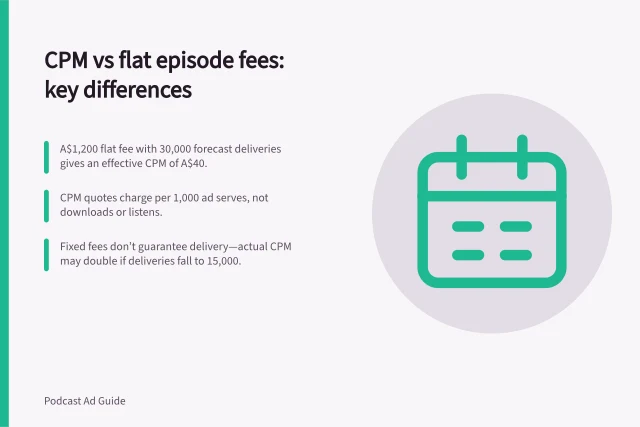
Before booking, compare the seller’s total quoted price for the delivery volume required, including any separately stated fees, with the available test budget. If the quote does not fit, reduce the proposed volume only if the test can still meet its outcome target; otherwise treat the buy as a delivery and response-path check rather than a message judgement.
State in advance what would justify continuing, revising or stopping, and when the result will be inconclusive. Include the required delivery, minimum useful outcome count, a functioning response route, the observation period and an acceptable cost where relevant.
If delivery or recording fails, or the action count falls short of the agreed target, classify the result as inconclusive rather than judging the message. The target is an observation gate, not proof of causation.
If evidence is sparse, use what the buy established to improve the next forecast and report the message question as unresolved.