Buying Inventory
Podcast campaign budgeting
Build a podcast campaign budget across media, creative and measurement, then compare quotes and check whether the first buy can answer your question.
Set a ceiling for the whole campaign before committing money to podcast placements. Allow for media, creative work, a response or research method, and changes you may need to approve. The media amount left depends on what the campaign must achieve and what suppliers include in their quotes.
Start with a decision and a spending ceiling
Write down the main question the campaign should help answer. If the aim is to generate qualified enquiries, fund a working enquiry route and a way to assess lead quality. If the aim is to measure a change in brand awareness, establish whether a suitable study is feasible before assigning the whole budget to placements.
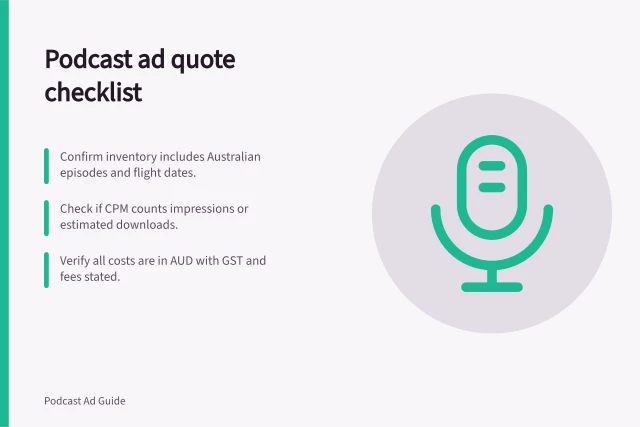
Set the ceiling in Australian dollars and define the campaign period. Ask whether each quote includes GST and compare totals on the same basis. Add any separately charged agency, platform, production or research work before calculating the media amount available.
Allocate the full cost
| Budget line | What to check |
|---|---|
| Media | The booked placement or ad-delivery unit, dates, forecast and any commitment |
| Creative | Writing, recording, talent, editing, approvals and additional versions |
| Response or research | The destination, outcome recording or study needed for the main question |
| Changes | Who may approve a new recording, replacement version or schedule change, and at what cost |
A change allowance is a planning choice, not a standard percentage. If the ceiling will not cover the proposed work, reduce the scope knowingly: fewer placements, fewer creative versions or a narrower question may be more useful than leaving a necessary response route unfunded.
Key Budget Allocation Components for Australian Podcast Campaigns
- Media Cost
- Booked placement, dates, forecast, commitment
- Creative Cost
- Writing, recording, talent, editing, approvals, versions
- Response or Research Cost
- Destination, outcome recording, study setup
- Change Allowance
- Approval process and cost cap for revisions
Compare quotes before dividing the media amount
Quotes may use a CPM or fixed episode fee; compare the total payable against the approved media allocation.
For each proposal, record the total payable and Australian eligibility, then check that the cost fits the media amount available. Confirm any terms that could affect the final spend before booking.
If targeting is part of the proposal, record the selected options for comparison.
Check whether the first buy can answer the question
Work backwards from the outcome you need to observe. For a response campaign, decide how many qualifying actions would make the review useful and whether the proposed delivery could plausibly provide them. For a brand study, ask the research provider whether the covered inventory and expected sample can support the comparison you want to make.
A small placement can check whether the audio, destination and reporting process work. Sparse response cannot reliably settle whether the message is persuasive. If the budget cannot support the original question, describe the buy as a setup check or narrow the decision.
How to Validate if the First Buy Can Answer Your Campaign Question
- Define required outcome (e.g., number of qualified leads)Ensure target is measurable and aligned with business goal
- Assess if proposed delivery can plausibly achieve itConsider reach, frequency, and audience alignment
- Confirm feasibility of response tracking methodVerify landing page, UTM tagging, or form integration
- If not feasible, reframe as a pilot or narrow scopeAvoid unfunded lead paths; use small buy for testing
Price targeting as a budget choice
Acast’s campaign pricing shows how targeting can change media affordability. Its listed options include free country targeting and show-language selection; targeting by region, sub-region, city or postcode adds 20%. The menu also lists Business & Finance category targeting at +20%, demographic categories at +40%, audience attributes at +20%, custom show lists at +50% and device targeting at +20%.
Treat those figures as supplier-specific menu prices, not a general podcast rate card. Acast says its campaign price updates when targeting options are selected or deselected. Compare the displayed total for the targeting actually proposed with the ceiling, rather than budgeting from a basic campaign price alone.
Acast also states that adding one option or several options within a targeting category does not change that category’s price. When building a quote comparison, record which categories are selected and use the supplier’s displayed total.
Acast Targeting Options and Price Impact on Podcast Campaigns
- Targeting Option
- Free country targeting and show-language selection
- Region, sub-region, city or postcode
- +20%
- Business & Finance category
- +20%
- Demographic categories
- +40%
- Audience attributes
- +20%
- Custom show lists
- +50%
- Device targeting
- +20%
Pros and Cons of Using Supplier-Specific Targeting Pricing Models
- Pros
- Transparent pricing tiers; allows accurate budget forecasting
- Cons
- Pricing varies by supplier; not standardised across platforms
Check the measurement basis in the reconciliation
If a proposal or report relies on measurement of downloaded media and the ads included in those downloads, ask the supplier to identify the counting basis used. Reconcile the reported quantity with the unit in the booking.
Companies can apply for compliance with the guidelines, but the compliance details are defined separately. A reference to the guidelines alone therefore does not establish a supplier’s compliance status. Ask what status applies to the measurement being reported before relying on it in the campaign close.
Close against the approved budget
Keep the approved amounts, order, creative version and authorised changes together. Compare the invoice with the agreed charges and the seller’s report with the booked unit. Review recorded business actions within their stated observation window and use the remaining uncertainty to plan the next buy.
In this guide
- Comparing CPM quotes with flat episode feesCompare podcast CPM quotes with fixed episode fees using the same delivery unit, then check total cost, forecasts and booking terms.