Buying Inventory
Buying podcast advertising inventory
Choose podcast ad inventory by booking unit, Australian eligibility, delivery definition and order terms.
Decide first what the campaign must buy: a placement in a named episode, sponsorship of selected shows, or ad delivery across eligible shows. Give sellers the same Australian audience, dates and creative brief.
Before approving an order, confirm what is fixed, what is forecast, how delivery will be counted and what happens if the plan changes.
Turn the brief into a request
State the product, intended audience, relevant Australian locations, campaign dates, message format, content exclusions and outcome you will review. Say whether a particular host, show or episode is essential.
Ask for the proposed shows or the rules that select eligible inventory. Request a forecast for the Australian market, and ask what geographic targeting the seller can actually provide.
A show's total audience is not a forecast of Australian delivery for your ad. Selection of an Australian audience also does not necessarily allow targeting by state or city.
For sponsorship proposals, provide enough context for a show to assess the fit: identify the brand, explain the campaign goal and describe the intended timeline. Keep the proposed show list and any non-negotiable exclusions explicit so approval does not silently change the inventory you expect to receive.
Ask when the seller will confirm show approval and issue the final plan. If approval is pending, record that status in the booking schedule and avoid treating an unapproved show as secured inventory.
Allow time for show approval
Acast’s booking guidance describes a sponsorship process that starts with selecting shows in its Sponsorships Marketplace. Its filters include target market and podcast categories, and show information can include weekly listens in the target market and audience demographics and interests.
For each proposed show, request its weekly listens in the target market and available audience demographics and interests, and specify relevant categories.
Acast asks for a company and campaign proposal before it contacts podcasts. The requested details include brand name, campaign goals and description, and timeline. It recommends naming a campaign with what is being promoted and the start date, so the seller can pass details on for advertiser approval.
In Acast’s process, podcasters approve advertisers before the booking is final. The draft media plan sets out proposed shows, campaign duration options and estimated impressions; after feedback and show approvals, an updated plan identifies the approved podcasts. Check that approved list against the shows you intended to buy before confirming.
Acast’s booking guidance describes a typical process of four to six weeks, while its sponsorship comparison guide says requests should be submitted at least four weeks before the desired air date. Treat those timings as Acast-specific planning guidance, not a general booking guarantee.
Typical Timeline for Podcast Ad Bookings in Australia (Acast)
- Submission of request
- At least four weeks before desired air date
- Show approval process
- Four to six weeks
- Final plan confirmation
- After feedback and podcaster approvals
Know what the booking gives you
| Buying unit | What to pin down | Main uncertainty |
|---|---|---|
| Named episode | Episode, release date, ad position and whether the message remains in the file | Eligible downloads may differ from the forecast |
| Show sponsorship | Named shows, active weeks, eligible episodes and available geographic controls | Sellers define and deliver sponsorship differently |
| Audience-targeted delivery | Targeting rules, eligible shows, flight and delivery goal | The show mix may change as eligible requests arrive |
These describe possible orders, not fixed industry packages. A host read can be inserted dynamically, and a produced ad can run in selected shows. Ask separately who voices the message, where it appears and how it is delivered.
Compare proposals on the same basis
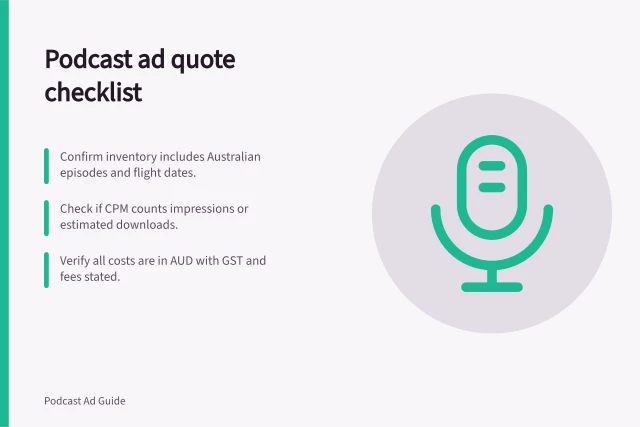
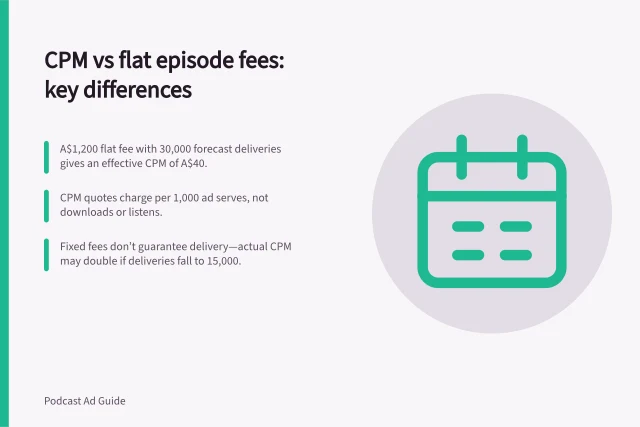
Record the booked unit, Australian eligibility, dates, show or episode controls, creative responsibilities, forecast and total amount in Australian dollars. Separate a guaranteed placement or delivery commitment from an estimate.
If one proposal quotes episode downloads and another quotes delivered ads, ask for definitions before comparing their totals.
Ask which metric governs billing, which measurement method the seller uses and what the final report will contain.
Key Metrics and Definitions in Australian Podcast Advertising
- Forecast vs. Actual Delivery
- A show's total audience ≠ Australian delivery forecast
- Geographic Targeting Limitations
- Australian audience selection does not guarantee state or city-level targeting
- Billing Metric
- Agree on which metric governs billing (e.g., impressions, downloads)
- Measurement Method
- Confirm whether PTM v2.3 or another method is used
Agree on changes before signing
Confirm the creative, duration, position, production responsibilities, approval deadline and any revision charges. State what happens if an episode is delayed, a show becomes unavailable or a delivery commitment is missed. Define when replacement inventory needs your approval and what makes it an acceptable substitute.
An ad embedded in an episode may remain available after the campaign ends. A dynamically inserted ad may run in eligible older episodes during its flight. For a time-limited offer, ask how an expired or incorrect message can be stopped or corrected.
For a sponsorship, clarify whether each selected show must approve the advertiser and what happens if a show declines.
Check delivery against the order
Request a report using the agreed unit and dates. Reconcile named episodes and placements with an episode booking. For a targeted campaign, compare reported ad deliveries with the agreed goal, geography and eligible inventory. Record substitutions and any make-good separately.
Review the business measure chosen in the brief, such as qualified enquiries or recorded orders, alongside media delivery. An observed action may have other causes, while a delivered ad may have an effect your response system cannot see.
In this guide
- Direct podcast bookings versus network packagesCompare direct podcast bookings with network packages by show control, coordination, reporting and substitution terms.
- Comparing podcast inventory sold by episode or audienceCompare episode-led podcast placements with audience-targeted delivery by booking unit, Australian eligibility and reporting.
- Checking what a podcast advertising quote includesCheck podcast quotes for inventory, delivery units, creative costs, GST treatment, substitutions and reporting before approving an order.