Buying Inventory
Part of Podcast campaign budgeting
Comparing CPM quotes with flat episode fees
Compare podcast CPM quotes with fixed episode fees using the same delivery unit, then check total cost, forecasts and booking terms.
Compare a CPM quote with a flat episode fee using the same forecast of eligible ad deliveries. Check the total payable and the booking terms. A calculated effective CPM makes a fixed fee easier to assess; it does not turn the forecast into a delivery guarantee.
Establish what each quote prices
CPM means a charge per thousand stated units. Ask whether a podcast seller prices ads served, episode downloads or another event. Acast describes its campaign price as a cost per thousand ads served. That definition does not automatically apply to another seller or prove a listen occurred.
A flat fee may buy a named episode, several releases or a sponsorship period. Record the show, dates, ad position, Australian eligibility, creative work included and any replacement terms. Ask whether the fee changes if actual delivery differs from the forecast. A fixed price and a fixed quantity are separate promises.
Calculate on a common basis
When both forecasts use the same ad-delivery event:
- Estimated CPM spend= forecast eligible ad deliveries ÷ 1,000 × quoted CPM.
- Illustrative effective CPM of a flat fee= flat fee ÷ forecast eligible ad deliveries × 1,000.
- Total payable= media plus any separate production, talent, platform or agency charges, compared on the same GST basis.
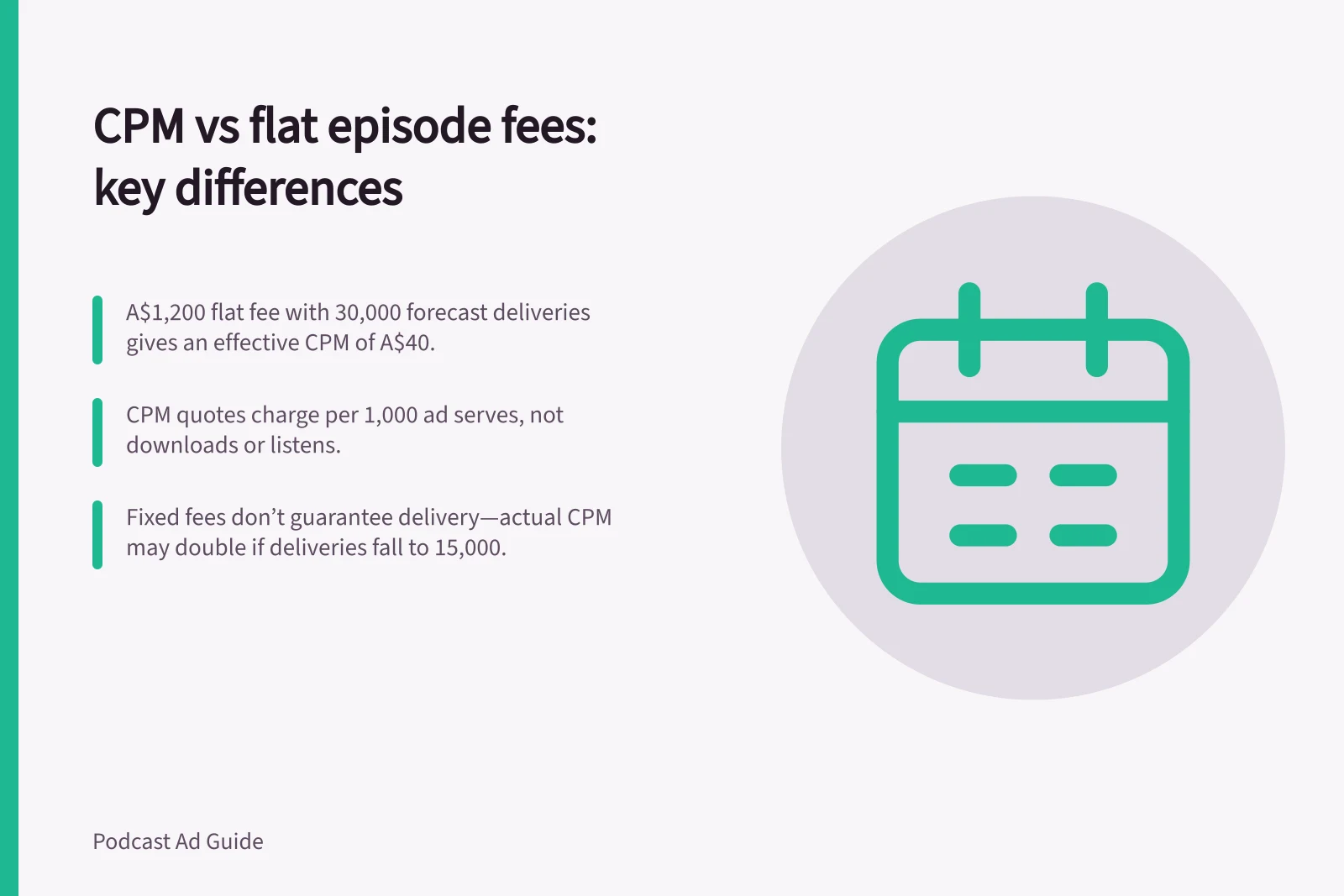
For a hypothetical Australian campaign, a A$1,200 episode fee with 30,000 forecast eligible ad deliveries gives an illustrative effective CPM of A$40. A A$35 CPM quote on the same forecast gives estimated media spend of A$1,050.
If the fixed-fee placement ultimately records only 15,000 deliveries on that same definition, its actual effective CPM is A$80. These figures illustrate the arithmetic; they are not market quotes or results.
The lower estimate may still buy different inventory, creative or approval rights. Decide whether those differences serve the campaign before choosing on price.
Test the denominator
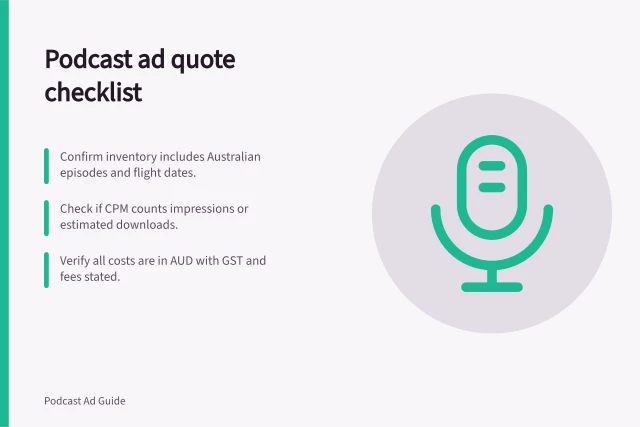
Ask for the forecast period, Australian geographic basis and the method used to estimate deliveries of this ad. A show's total downloads may include requests outside Australia or requests that never receive a dynamically inserted campaign ad. For an embedded ad, ask how the seller estimates delivery of the episode segment containing it.
Ask what the reported count represents. If the fixed-fee seller can provide only episode downloads, label the calculation cost per forecast download and keep it separate from a quote priced per delivered ad.
Check a lower-delivery scenario for the fixed fee. For the CPM order, ask whether spend is capped, whether delivery is committed and what happens if eligible supply falls short. None of these terms follows from the pricing label alone.
Decide from the written terms
Put the proposals side by side: total payable, priced and reported unit, Australian eligibility, forecast, any guarantee, named placement or targeting rules, included creative work and shortfall remedy. Request a revised quote if a material field is missing.
After the campaign, calculate an actual effective CPM only if the final fee and final count use the agreed ad-delivery unit. Report any named placement and recorded business response separately; neither an estimated delivery nor a server count is a confirmed listen.