
Measurement
Podcast media reporting
Build a podcast campaign report that separates booked media, reported ad delivery, recorded response and measurement limits.
A podcast media report should show three things: what was booked, what the publisher counted as delivered, and what the advertiser recorded afterwards. Keep those findings separate. A completed placement does not prove sales impact, and a favourable response figure does not resolve a missed placement.
Establish the reporting basis
Start with the campaign, Australian target area, flight dates, included shows or eligible inventory, creative versions and booked unit. State the cut-off date for each dataset. An episode released near the cut-off may continue to accumulate downloads, while an advertiser's response window may close later than the media flight.
Identify whether the order commits to named placements, a quantity of ad deliveries or both. Label forecasts separately from delivery obligations, and refer to the agreement to determine whether any forecast is binding.
Present the media account
For each booked item or reporting group, show the agreed inventory, dates, position, creative, quantity where applicable, reported delivery and approved changes. Mark exceptions that remain unresolved. Preserve the original booking beside any approved substitution so the reader can see what changed.
An episode download and delivery of a particular ad are different events. A reported ad delivery is not confirmation that the ad was played.
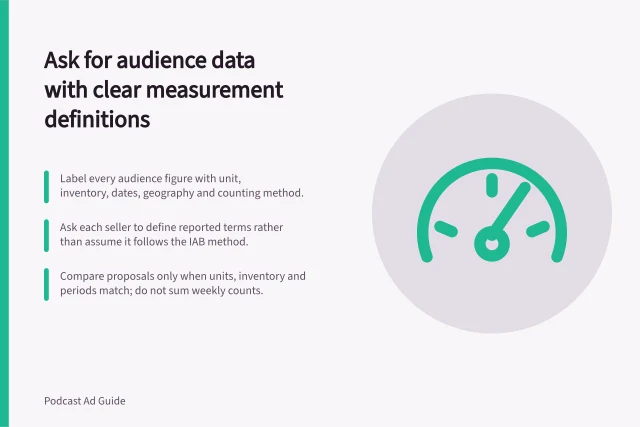
Ask the publisher what its reported impression counts; the label alone does not establish that it follows this method. A copy of a named episode can show the ad present in that copy, while a delivery report is needed to assess reported distribution.
Put response beside delivery
Choose response measures that fit the objective, such as accepted-code orders, qualified enquiries or a suitable brand study if one was commissioned. For each, give the source system, eligibility rule and observation window. Do not add visits and orders as though they were separate people.
Describe code use as recorded code use. A code may circulate beyond the podcast audience, and an influenced customer may buy without it. A sales increase during the flight may also have other causes. Any study conclusion needs its own population, method and uncertainty beside it.
| Report section | Question answered | Limit to show |
|---|---|---|
| Booking and changes | What was agreed? | Separate commitments, forecasts and later approvals. |
| Publisher delivery | What did the seller count? | State the event, method and covered inventory; delivery does not establish listening. |
| Advertiser response | What entered the advertiser's records? | State what the system may miss or include from other routes. |
| Study, if available | What difference did the study estimate? | Keep the conclusion within its design and coverage. |
Make the method visible
Add a methods note identifying the measurement framework and version used by the publisher. Describe the relevant measurement basis in plain language. The advertiser can then interpret a reported result and distinguish it from a count produced under another approach.
State whether the reported campaign coverage includes audio, video or both, and whether episodes were distributed through open RSS feeds or podcast applications relying on server-side file delivery.
Record the measurement window approach used for valid downloads, particularly where reports from different publishers or platforms are being compared. Ask each publisher to disclose the window used and flag differences as a comparability limit rather than presenting the totals as directly equivalent.
Note material technical changes that may affect measurement coverage, including URL prefix measurement or changes to an RSS enclosure URL. A concise exception note can identify the affected reporting period or inventory, explain whether the publisher addressed the change in its method, and leave any unresolved coverage uncertainty visible.
Include a brief statement about invalid-traffic treatment and the responsibilities assigned to the platform for anti-fraud measures. Ask the publisher whether these matters were addressed in the reported figures or remain an open limitation. The report need not reproduce technical detail.
When reports differ, describe the discrepancy and what evidence is available to explain it. Avoid treating figures as comparable until differences are understood.
Treat a reference to IAB Tech Lab guidance separately from a claim of compliance. If compliance is relevant to the advertiser’s assessment, ask for evidence of the publisher’s compliance status and report only what the publisher has actually disclosed; naming the guidance alone does not establish that status.
Close with a decision
State which booked obligations are supported by the evidence, which exceptions need resolution and what response was recorded. Then say how strongly the evidence supports the campaign objective. Name the missing item and its owner when a conclusion must wait.
A short decision statement, a reconciled media table and a labelled evidence appendix let someone who did not manage the buy understand the result. For future reports, agree in advance which evidence will support delivery, how exceptions will be recorded and when the report will be finalised.
In this guide
- Reconciling booked episodes with delivered ad impressionsCheck named podcast placements and ad-delivery commitments against the order, publisher report, creative evidence and approved changes.
- Reporting promo-code sales without claiming complete attributionReport accepted promo-code orders, sales adjustments and code coverage while making the limits of podcast attribution clear.
- Comparing podcast results with other audio formatsCompare podcast results with streaming audio and broadcast radio while keeping delivery methods, audience estimates and response limits clear.
- Explaining measurement uncertainty in a podcast reportQualify podcast delivery, estimated reach, code sales and study findings beside each result, with clear effects on campaign decisions.