Measurement
Podcast advertising measurement
Plan podcast ad measurement across delivery, recorded response and brand effect, with clear definitions and limits for Australian campaigns.
Plan the campaign around three separate questions: what delivery was reported, what advertiser-side actions were recorded, and whether evidence shows a change in the intended outcome. Choose the primary question before launch, then agree definitions, evidence sources and an observation period; interpret each finding against that plan. No single figure answers all three.
Choose the question first
A delivery question asks whether booked ads reached eligible Australian inventory. A response question counts qualifying orders or enquiries recorded through a defined route. A brand-effect question asks whether awareness, recall or consideration changed because of the campaign. That last question needs a suitable study; a rise during the campaign is not enough.
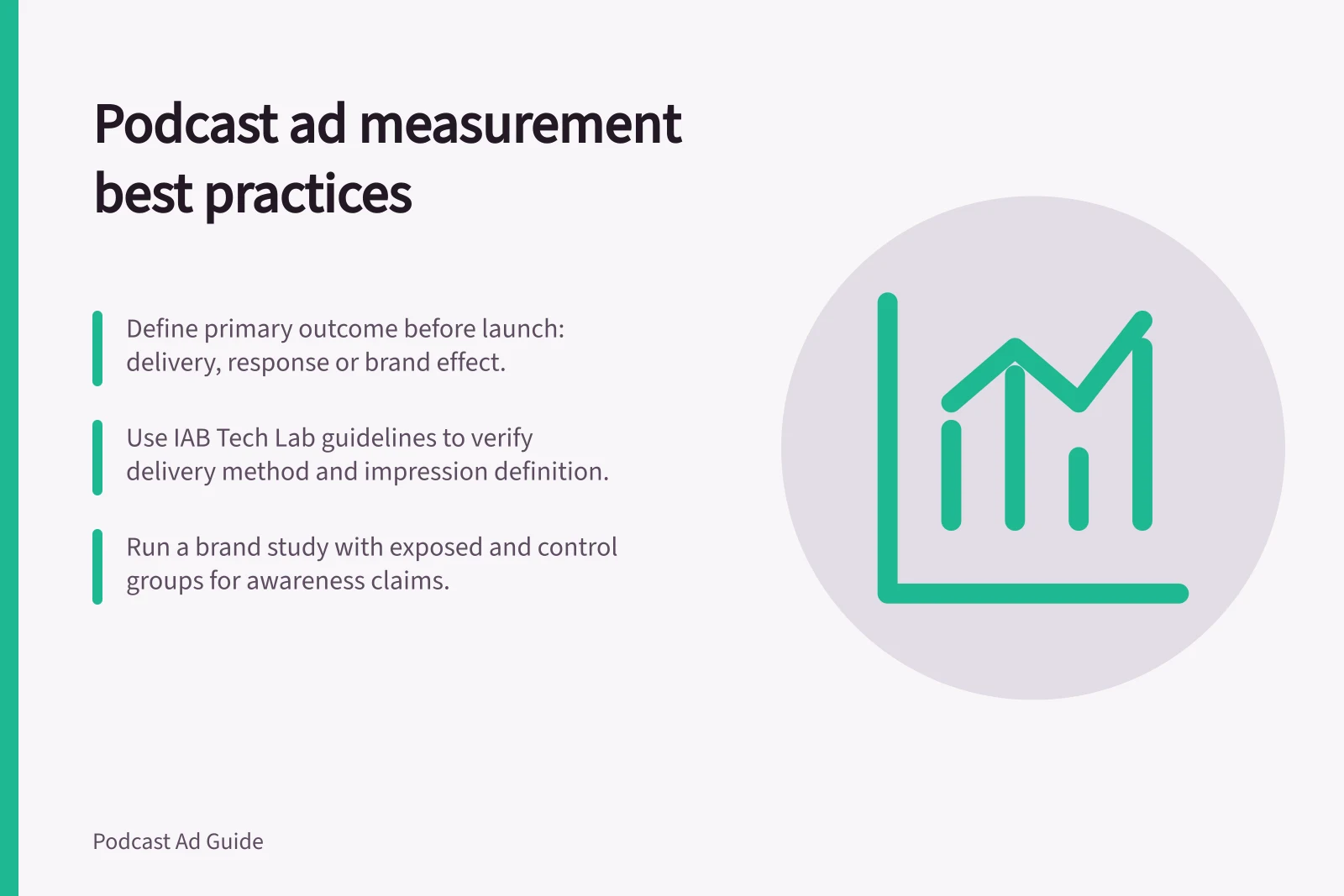
Choose one primary outcome that fits the objective. Record audience, dates, creative and response window with it. Keep secondary signals, but do not redefine success after seeing the results.
In 2025, 79% of agencies intended to increase podcast investment, according to IAB Australia’s Audio Advertising State of the Nation 2025 Report. Measurement and evidence of effectiveness remained top issues for streaming digital audio and podcast advertising.
| Evidence | What it can show | What it cannot establish alone |
|---|---|---|
| Publisher delivery report | Ads counted under the seller’s stated method | That each ad was played or heard |
| Advertiser response records | Actions visible to the specified system | Every response influenced by the campaign |
| Suitable brand study | A difference under its study design | An exact effect across all Australian listeners |
Key stats on podcast advertising in Australia
- Agencies planning increased podcast investment (2025)79%
- IAB Tech Lab Podcast Technical Measurement Guidelines versionv2.3
- Platform used for Google Display & Video 360 Brand LiftAvailable for eligible podcast inventory
Align measurement across channels
Podcast exposure may sit alongside other media, and responses may occur across platforms or devices. Agree whether to assess the campaign on its own or within a broader media mix, and identify which systems can contribute evidence.
Where log-level data is available, an attribution model can estimate how channels contribute to a final conversion rather than relying only on last touch. Treat that model as an attribution view, not proof that a podcast ad caused a particular sale.
Consider whether the analysis can assess incrementality or online-to-offline outcomes. These approaches can help examine whether tactics added impact or whether people exposed to an ad later bought a product, but the analysis still needs evidence suited to the question.
Check the delivery definition
For downloaded podcasts, reporting approaches can differ. IAB Tech Lab’s Podcast Technical Measurement Guidelines, version 2.3, address measurement of downloaded media and ads included in those downloads. Treat the guidelines as technical guidance, not an automatic guarantee of a seller’s compliance.
Companies can apply for compliance with the guidelines, with compliance details defined separately. Ask the seller which measurement method it uses and whether it has applied for compliance; consult IAB Tech Lab’s separate compliance programme for details.
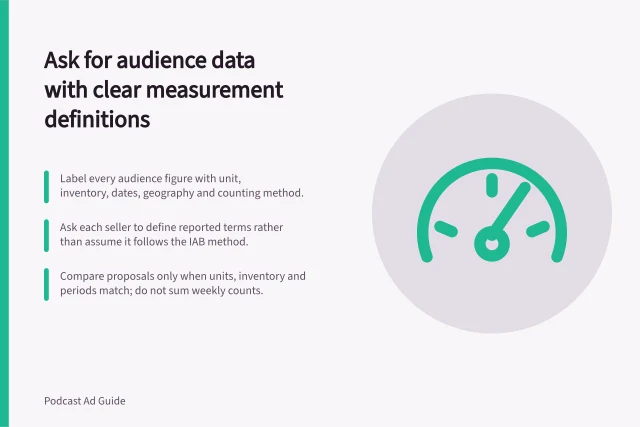
Ask what an “impression” means in the proposal and final report. Confirm booked unit, filtering method, dates, Australian geographic basis and inventory covered. A show’s episode downloads are not automatically deliveries of your creative. Do not assume every seller uses the same method.
A delivery figure does not by itself establish that a listener paid attention. Ask the seller to explain how it measures and reports delivery, and what its figures represent.
Allow for publisher differences
Reports from different publishers may not be directly comparable, even when they use the same metric label. Measurement approaches can differ across publishers and platforms. Spotify and Acast are not included in CRA’s monthly podcast ranker, which uses Triton Digital data; they sell using their own insights and first-party data.
Before combining results, record each seller’s definition, coverage and method separately. The ranker can give a starting point for market context, but it does not make every publisher’s figures equivalent. If methods differ, qualify the comparison; do not treat a difference in reported results as a difference in campaign effectiveness.
Set up an observable response
Give listeners a suitable next step, such as a code for an eligible purchase or a dedicated enquiry route. Define which advertiser system establishes the outcome and how cancellations or refunds affect the count. Check the route and recording work before launch.
Common response signals include promo-code redemptions, vanity URLs and pixel-based attribution. Choose a route that records the outcome in an advertiser system, and keep response measures separate.
A customer may visit a campaign page and later use a code; a code may be shared beyond the podcast audience. Recorded actions are useful, but neither a complete count of influenced customers nor proof that every action was caused by the ad.
Use a study for a brand-effect claim
If the primary goal is awareness or consideration, ask how a proposed study forms exposed and comparison groups, what counts as exposure, who can be surveyed and how many responses it expects. Agree the study’s expected sample and uncertainty with its provider before the campaign. Confirm its availability for the actual buy.
Google Display & Video 360 has a Brand Lift measurement setup; ask whether it is available for the booked podcast inventory and eligible survey audience. A platform study may cover only inventory where that provider can identify and survey eligible people.
Read any measured difference with its sample, uncertainty and coverage. A before-and-after survey without a suitable comparison can reflect other advertising, events or changes in who answered.
Report findings by outcome
Report delivery, recorded response and brand effect as separate findings. For each, state the supporting evidence; report a brand effect only when a suitable study supports that conclusion.
Use the primary outcome as the decision rule for rebooking. If delivery fails its agreed definition, resolve that before judging effectiveness; if delivery is sound but the primary outcome is not supported, do not call the campaign successful on delivery alone.
Interpret the campaign in context
Use those qualified findings to decide what to retain in the next campaign. Decide what to change. A rebooking decision should reflect the primary outcome and the strength and limits of its evidence, not a single delivery or response figure.
In this guide
- Downloads, listeners and ad impressions explainedLearn what podcast downloads, listener estimates and ad impressions count, and which definitions to request before comparing Australian campaign reports.
- Measuring response from podcast promo codesSet up podcast promo codes, count accepted actions and read redemptions without treating them as complete campaign attribution.
- Evaluating podcast brand lift without overstating certaintyCheck podcast brand lift study groups, exposure definitions, Australian sample coverage and uncertainty before drawing a campaign conclusion.