Host-Read Ads
Part of Podcast creative experiments
Comparing short and long audio calls to action
Test whether extra words in a podcast call to action help listeners take the intended next step, while keeping the offer and delivery comparable.
Compare short and long podcast calls to action when extra words have a specific job, such as explaining what listeners will find at the destination. Keep the preceding message, offer and route consistent. The test asks whether added closing detail improves the chosen outcome for this campaign; it cannot establish an ideal length for every ad.
Specify what changes
The short closing should give one action and one spoken route. The longer closing may add a brief explanation of the next step or destination. If it adds a discount, deadline or new product claim, the test also changes the offer or message.
Put an essential condition in both versions. Shortening a line must not make a limited offer sound unconditional. Read each closing aloud with the brand and route to check for confusing sounds or rushed wording. A one-hearing clarity check can identify an editing problem; it does not measure audience response.
Illustrative pair: Short — Visit [spoken route]. Long — Visit [same spoken route]. The page explains [specific next-step detail] and what to do next. Replace the placeholders with details that are true of the destination, and keep the offer and any condition identical.
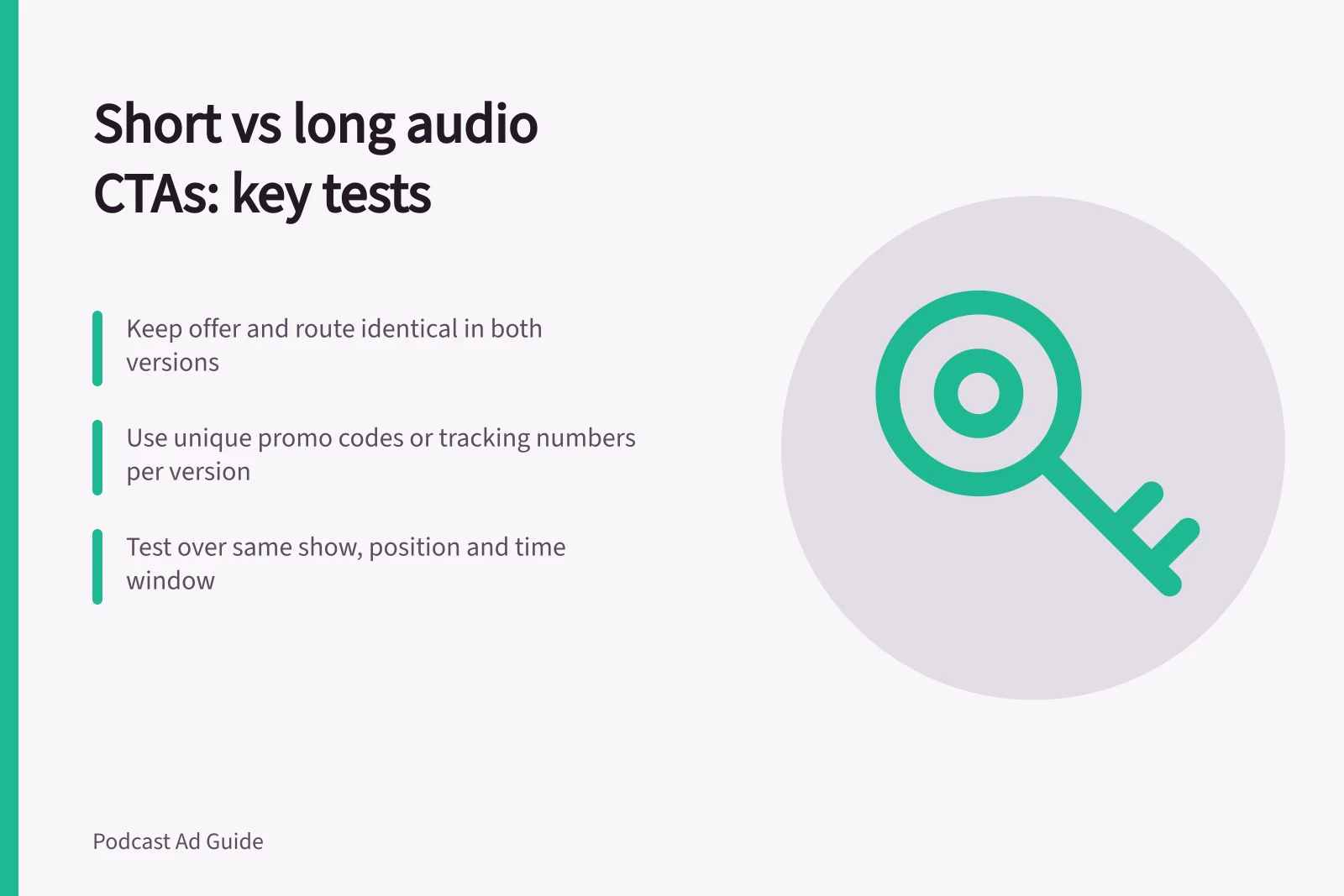
Choose one response instrument before launch. If your destination can record version-level tracking parameters behind the same spoken route, use them to distinguish responses. Alternatively, use a unique promo code or dedicated call-tracking number for each version, but treat the spoken identifiers as another creative difference.
For a direct-response CTA, compare tracked responses by version, such as visits recorded against a unique URL, promo-code redemptions or calls to a dedicated number. Choose one primary outcome in advance; if the goal is an enquiry, define what counts as a qualified enquiry before launch.
Short vs Long Podcast Call to Action: Key Differences
- ActionOne clear action in both versions
- RouteSame spoken route (e.g., 'Visit podcastadguide.com')
- Additional Detail (Long Version)Brief explanation of next step or destination (e.g., 'The page explains how to claim your free trial')
- Creative DifferenceOnly the closing detail varies; all else is consistent
Check the booked duration
Keep the speaker, main explanation and production treatment the same up to the closing. Ask which durations the booked placement accepts and whether a longer file changes inventory or price. If it does, that difference will complicate the result.
Equal runtime does not create a pure word-count test either. Filling the short version's remaining time with a pause or sign-off changes pacing. Record the two complete closing treatments and describe the comparison that way.
Keep separate creative IDs. Check the route and any code in the final audio, then confirm that the destination provides what both versions promise.
Testing Short vs Long Audio Calls to Action
- Align speaker, message and productionEnsure consistency up to the closing line
- Confirm booked duration limitsCheck if longer files affect inventory or price on Australian platforms
- Use unique tracking for each versionApply distinct promo codes, URLs or call-tracking numbers
- Define primary outcome before launchE.g., qualified enquiry, visit, code redemption – must be measurable
- Compare results over same windowAccount for differences in delivery, spend and response rates
Give both closings comparable opportunities
Ask whether the seller can allocate both versions across the same eligible Australian shows, positions and period, and report delivery by version. Fixed episode placements may force different episodes or dates; record that limit. Compare the preselected outcome over the same window, accounting for unequal delivery or spend.
Set the test window and decision rule before launch. Call the longer version a winner only if the improvement meets the campaign's pre-set business threshold and the result is precise enough for the decision; otherwise, treat the result as inconclusive. Use an adequate sample in each version for the precision you need, recognising that smaller differences require larger samples.
Keep response totals, delivery and spend for each version. If delivery differs, compare responses per delivered ad as well as raw totals; if spend differs, report cost per tracked response too. These comparisons make imbalances visible but do not correct for different shows, positions or audiences, so avoid claiming a clean length effect when allocation is materially different.
A suitable outcome depends on the action. If both closings invite an enquiry, define a qualified enquiry before launch. For downloaded podcasts, publisher ad-delivery counts do not establish that every closing was played through to the end.
If the longer closing delivers a useful, credible improvement under comparable conditions, retain its added detail for a similar placement. If the result is unclear, keep the performance question open. Where both lines communicate the action and there is no reliable reason to use extra time, choosing the shorter line is an editorial judgement rather than a measured win.
Key Metrics for CTA Testing in Australia
- Response per Delivered Ad
- Compare performance across equivalent placements
- Cost per Tracked Response
- Report this when spend differs between versions
- Qualified Enquiry Definition
- Must be defined pre-launch (e.g., form submission with ABN details)
- Sample Size Requirement
- Larger samples needed for small performance differences