Measurement
Part of Podcast campaign landing pages
Tracking typed visits and code redemptions separately
Separate visits to a spoken podcast URL from accepted code orders, and learn why neither measure proves who heard the ad.
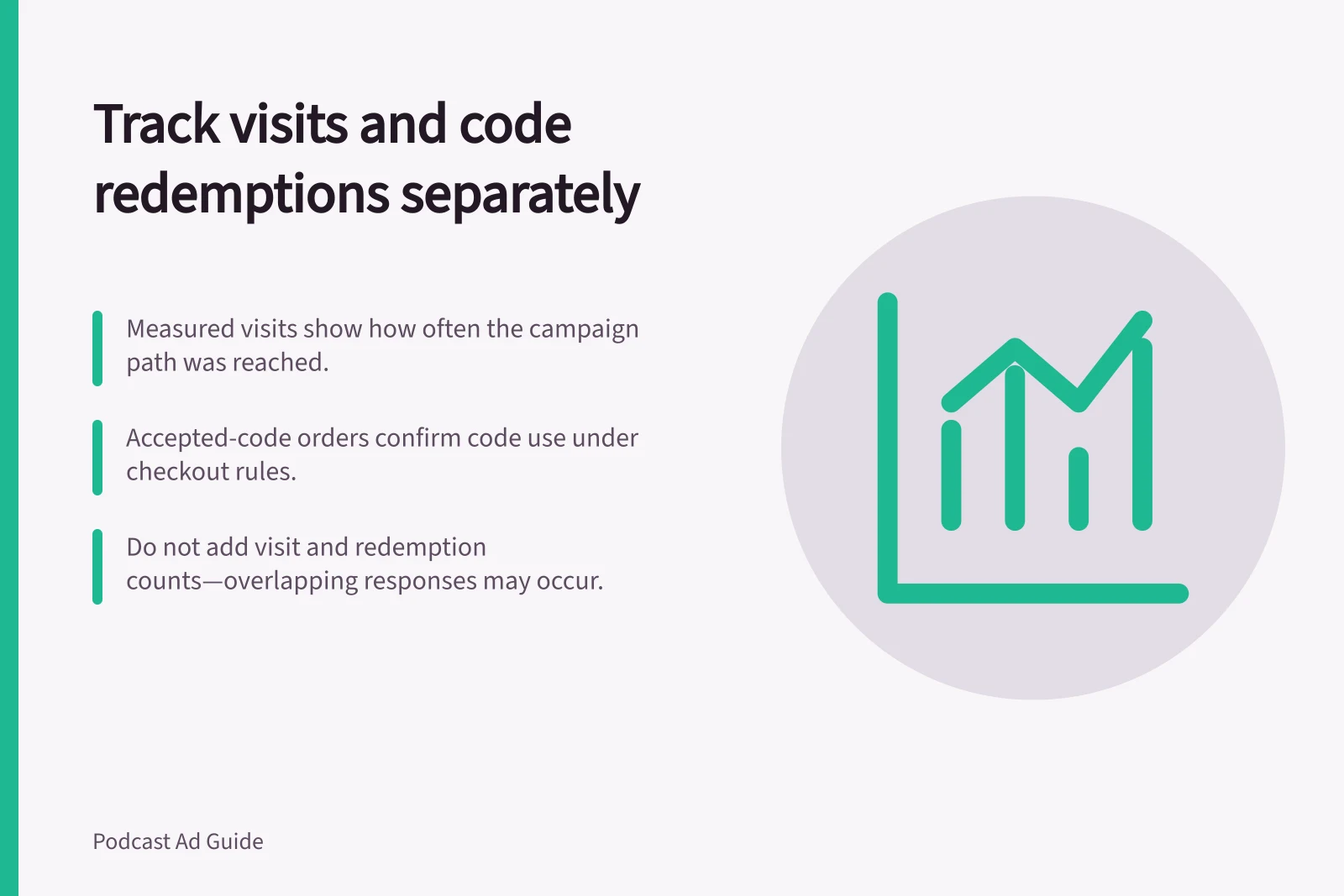
Track visits to the spoken destination and accepted code redemptions in separate records. A campaign path cannot reliably show which visitors typed its URL, and a code cannot show who heard the ad. The same customer may appear in both records.
Define each measure
A measured visit to a dedicated page path shows the path was reached. The visitor may have typed it, followed a shared link or opened a companion post.
In Google Analytics 4, some visits are recorded as “(direct) / (none)”. Typed addresses are only one possible cause, alongside lost or missing source information, so do not label every direct visit as typed podcast traffic.
An accepted-code order shows code use under the checkout system's rules. A customer might remember the code and reach checkout another way; the code might also be shared beyond the audience.
| Record | What it shows | What it cannot show alone |
|---|---|---|
| Measured visits to the path | How often the destination was reached under the chosen metric | Whether the address was typed or the visitor heard the ad |
| Visits from a tagged companion link | Use of that link when its tags reach Analytics | Responses that did not use the link |
| Accepted-code orders | Orders on which the sales system accepted the code | Whether the customer heard the podcast |
Prepare separate records
For the destination, record the path, campaign dates, redirects and reporting definition. Choose sessions, users or page views, then use that unit consistently. Check whether redirects preserve tags on clicked links. Report tagged visits separately from other visits to the path.
For redemptions, record the code, eligibility, validity dates and the order identifier used for reconciliation. Use the order system to establish whether a code was accepted. GA4's Order coupons report summarises recorded coupon data; a populated coupon record is not, by itself, proof that checkout accepted the code.
GA4 provides a way to minimise duplicate key events using transaction IDs, which depends on correct IDs being supplied. Compare analytics with the order system rather than assuming the totals match.
Key Metrics for Campaign Tracking in GA4
- Visits to campaign path
- Sessions, users or page views (consistent unit)
- Accepted-code orders
- Order identifier used for reconciliation
- Coupon data validation
- GA4 Order coupons report – not proof of acceptance
Reconcile without adding the totals
One person can visit the page and redeem the code, so adding those counts can double-count response. Report them side by side for the same campaign period and outcome window. If a reliable, permitted match between records is available, show the overlap separately; otherwise say it is unknown.
Investigate a wrong redirect, failed code, missing coupon data or duplicate purchase event before interpreting differences. State how cancellations and refunds are treated. In the final report, “visits to the campaign path” and “orders using the code” describe the observations without claiming a total number of podcast-driven customers.